
How Doctors Diagnose Things (An Explanation of COVID-19 Testing Criteria)

correlation
Image credit: xkcd.com

I’m going to pause in my evaluation of the Medicare for All Act of 2019 just for a week to write as a physician for once rather than as a health policy researcher. And not to talk about coronavirus (SARS-CoV-2) so much as to explain a principle of clinical medicine I wish more people would understand, especially now when it’s particularly relevant.

Let me explain to you how doctors diagnose things.

Any diagnostic effort a physician does starts with making a list of possible causes of the patient’s problem. That list is called a “differential diagnosis,” or a “differential,” for short. Only when you have determined your differential can you make decisions about how to proceed working up or treating a problem.

Together, the likelihood of all those things on the differential add up to 100%. If one of those things goes up in likelihood (say, because of a positive test for that thing), by definition the other things on the differential go down in likelihood.

So, for example, the patient I saw today. She hadn’t traveled anywhere recently, she hasn’t been exposed to anyone with COVID-19, and she doesn’t live in an area where there are many COVID-19 cases–all in all, she was very low risk for having COVID-19. But some food she ate yesterday didn’t sit well, and she vomited but also tried to take a breath at the same time. That didn’t work out so well, and she was trying to cough the vomit out of her lungs after that. About a day later, she was still coughing and short of breath, but now she was having fevers. COVID-19 was on the differential (cough, shortness of breath, fever), but bacterial pneumonia secondary to aspiration was much more likely. Did we need to test this lady?

With the information I’ve given you, the answer is probably no. We are pretty certain her symptoms were from that aspiration event, which makes COVID-19 very unlikely.

But some patients with that same story would still get tested (which was the case with this patient), as I’ll explain using the principle of a “testing threshold.”

Every item on the differential diagnosis sits somewhere on the probability spectrum in between 0% and 100%. If you test for the disease, and the test comes back negative, it pushes that one down closer to 0%. (How far it pushes it toward 0% depends on how reliable the test is.) And if the likelihood of something on the differential is close enough to 0%, then you say it’s unlikely enough that you can essentially think of it as being ruled out.

How close is “close enough to 0%”? Or, in other words, how unlikely does something have to be before we don’t feel the need to test for it further? Or, in other other words, how do we decide where to set that testing threshold? That depends on a few things, especially how risky it is to miss the diagnosis. If we’re dealing with the patient above, and I told you she’s a 25 year old with no medical problems and she works from her computer at home, it’s not very risky to miss the diagnosis, and we’d counsel her to make sure she’s isolated until a few days after all her symptoms have resolved. But if that patient is 80 years old and has severe COPD, this is an incredibly high risk individual, and missing a COVID-19 diagnosis, unlikely as it is, would be catastrophic, so we would definitely test her.

Similarly, young healthy healthcare providers are considered high risk because of the potential consequences of missing that diagnosis in them. The consequences are not to them directly, but rather the consequences are to their patients they could potentially spread it to, many of whom are likely elderly or high risk in other ways. Therefore, healthcare workers’ testing threshold is also set very low.

So, if you have symptoms, check testing criteria. Call a hotline. They will ask you questions to figure out where your testing threshold is, and based on that they will decide if you need to get tested or not.

Evaluating Sanders’s Medicare for All Act of 2019, Part 1

This is a 7-part series. Here are all the links: Part 2, Part 3, Part 4, Part 5, Part 6, Part 7.

I spent a lot of time looking at Senator Warren’s plans for Medicare for All (M4A) because she committed to a lot of details on her official campaign website. Senator Sanders, on the other hand, had very little. But he did commit to many details in his Medicare for All Act of 2019.

Bear in mind, this is him working as a senator–not as a president–so it’s hard to know how much this represents what he would push for as president, although I suspect it would change very little. And, at the time of this writing, it’s looking less and less likely that he will become the democratic presidential nominee, so maybe this is all moot. However, you may have noticed that M4A is becoming a bigger conversation every year, and people who once said it’s impossible are starting to rethink their assessments, so I’m going to move forward with evaluating this proposal anyway because I believe considering different possible implementations of a single-payer system in the US will become increasingly important to getting it right if it is in fact going to happen.

Let me also give you a reminder about my approach to these things. I’m biased, as everyone is, but even if you’ve read my writings for a while, you probably still do not know where I fall on many issues. This is on purpose. Maybe its my apolitical Canadian upbringing, but I feel strongly that people should reserve judgment on any issue until they have a good grasp of both sides. In these posts, I am neither arguing for or against M4A; I am simply trying to supply some of those pros and cons of different proposed implementations.

Having said all that, one bias I am upfront about is that I believe markets work. Put more precisely, I fall on the decentralized side of the economic spectrum,which, as a reminder, is independent of the welfare spectrum.

Now, on to my evaluation of the Medicare for All Act of 2019 (hereafter referred to as the Act). It has 11 titles, so let’s go through them one by one to see what kind of fun they contain. I’ll be focusing on the main details that will determine the overall structure of the system and how the healthcare system is likely to function.

Title I

This is the general stuff. Every resident and, from what I can tell, every non-resident too, will get benefits and be auto-enrolled and receive a Medicare card, at which point they will have the freedom to see any qualified healthcare provider. The only people who will not receive benefits will be those who are coming to the U.S. specifically to freeload off the free benefits.

Until the Act takes effect, people can continue any current health insurance. But, after that, no one will be allowed to sell coverage that duplicates the benefits provided under M4A. That doesn’t mean they can’t sell supplemental benefit plans though.

There will certainly be arguments about who should be covered by M4A, and, unsurprisingly, this falls on the “cover basically everyone” side of the spectrum. There are other options. I’m not an immigration expert, but it looks like there are four main immigration statuses in the U.S.: citizen, permanent or conditional resident, non-immigrants (because they’re only here temporarily with a visa), and undocumented. It might be easier to only send Medicare cards to citizens and residents. But, from the provider side, it sure would be nice to just treat everyone who walks in the door without regard to their immigration status. There’s also a charity aspect to consider here–how do we care for these people who are undocumented? I have a hard time with this because I want to provide compassion and improve others’ lives, but I also don’t want to reward illegal behaviors with free health insurance at the cost of taxpayers.

Straight up getting rid of employer-sponsored insurance is a great move and will enhance simplicity so much in the healthcare system and in the tax code, plus it will enhance job portability. Insurance should never have been paired with employment anyway–it was just an accident of historical policies.

Ok I’ll leave off right there for this week. If anyone has a strong argument one way or the other about covering undocumented people with M4A, please share below.

Continue to Part 2.

Price Transparency, In as Few Words as Possible

I’m ready to move on from everything being about coronavirus (although the memes have been very entertaining), so let’s talk more about price transparency this week. After that, as requested by a reader, I’ll spend some time looking at Senator Sanders’s Medicare for All Act of 2019 to get more details about what flavor of M4A he would push for as president (since, if you recall, his official campaign website details were pretty scant).

Months ago, I read this interesting Vox article about President Trump’s healthcare price transparency efforts. They asked a number of experts what they thought the results would be of these policies.

Let me summarize what they said:

  • Consumers will start shopping for and finding lower prices
  • High-priced providers will be shamed into lowering their prices
  • Policy makers would see how high prices actually are and would be more motivated to enact policies to reduce them
  • People still wouldn’t shop for healthcare services even with price information because (1) they can’t during emergencies, (2) they will often hit their deductible and therefore not end up paying more for more expensive providers anyway, and (3) patients will continue to go to the same providers even if they’re more expensive because they’ve already established a relationship with them
  • Price information will only be actionable when it’s in an easy-to-understand consumer interface plus paired with insurance benefit design changes
  • Without being paired with quality information, people might incorrectly assume the expensive providers are higher quality
  • Providers could see the prices insurers are paying other providers and demand they get those higher prices as well

All of those predictions are, to various degrees and in certain situations, likely to come true. But they don’t tell the whole story.

What would I say, in as few words as possible?

Price transparency, by itself, will only remove one of many barriers to people making price-sensitive decisions in healthcare–other barriers will remain, especially insurance plan designs that negate price differentials between providers via their cost-sharing requirements for patients. But, in the big picture, getting more price-sensitive decisions in healthcare is not the goal. The goal is to get as many purchase decisions as possible to become value sensitive, which requires knowledge of both price and quality. Only when patients start making value-sensitive decisions will higher-value providers start to win market share and enhanced profitability, thus stimulating innovation toward greater value over time. So while the short-term observable benefits of a price transparency policy will be minimal, it is one of many essential steps toward fixing incentives and improving value in our healthcare system.

Maybe that wouldn’t be short enough to be quotable, so instead they’d just say they asked Dr. Taylor Christensen, who said, “the short-term observable benefits of a price transparency policy will be minimal.”

Who Likes Coronavirus, Insurers or Providers?

face mask on blue background
Photo by Anna Shvets on Pexels.com

We’re in the midst of the coronavirus hype, and I think this provides a great opportunity to review incentives in the healthcare system. How do providers and insurers feel about this new pandemic?

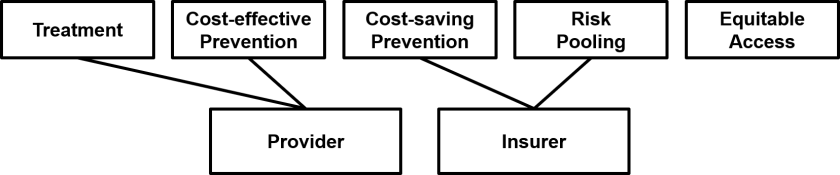
Insurers are hating it. They are going to have a big bump in the number of people going to doctors and hospitals, which means they are paying a lot more money to providers in 2020 than they had anticipated. Insurer profits are going to tank. They would rather people be healthy–that’s how they are able to keep more money as profit. This is why I say that insurers’ only job is not to provide risk pooling, but also they are motivated to increase cost-saving prevention.

Providers are loving it. Hospital beds and emergency departments and urgent cares are all going to be full, which means profits will soar. Sure, salaried providers (me) and also providers paid per shift aren’t actually too happy about seeing more patients for no extra money, but the hospital administrators are all looking forward to large quarterly bonuses.

jobs and parties

And just as a little bonus to help you sound smart, let’s get some coronavirus terms straight (since it seems most media outlets can’t!) . . .

Coronavirus is a little family of viruses. There are four of them that commonly cause infections in humans, and I see them all the time because they’re one of the types of viruses that often cause upper respiratory tract infections (i.e., “the common cold”).

Every once in a while, another member of the coronavirus family figures out how to infect humans. The most famous one is what caused the whole SARS excitement in 2003. SARS stands for severe acute respiratory syndrome, because that’s the type of infection it caused. So they decided to name that member of the coronavirus family SARS-CoV (CoV, if you didn’t figure it out already, comes from coronavirus). I guess once a virus starts infecting humans, it’s worthy of receiving a new and improved name.

And now, in 2019, another one figured out how to infect humans. It causes a respiratory infection similar to the 2003 one, so they cleverly decided to name this new virus SARS-CoV-2.

Fix this in your brain. The virus is called SARS-CoV-2. Honestly, though, you can just refer to it as “coronavirus” because I’m pretty sure people will know which member of the family you’re talking about.

The disease SARS-CoV-2 causes, however, has its own name: coronavirus disease (#inspired). But, for short, they call it COVID-19 (because it started in 2019).

So, when you are talking about the virus, call it SARS-CoV-2, or, less precisely, coronavirus. And when you’re talking about the respiratory disease that virus causes, you should be saying COVID-19, or coronavirus disease.

Why Providers Don’t Innovate

The last couple weeks, I’ve been writing about how innovation can solve our healthcare spending problem and why it’s not happening. Last week, I gave some thoughts on why insurers don’t innovate. This week, let’s talk about providers.

One of my favorite examples that illustrates some of the challenges providers face when they try to innovate is detailed in the book Transforming Health Care: Virginia Mason Medical Center’s Pursuit of the Perfect Patient Experience. It talks about how they noticed that a lot of patients were presenting with low back pain and were not getting optimal treatment, so they decided to do something about it. They completely redesigned their low back pain care pathway, cutting out all the unnecessary things and getting patients the beneficial things much quicker. They started getting patients back to work way sooner, and things were going great, except for one problem: by cutting out unnecessary MRIs for uncomplicated cases, they were losing a lot of profit.

This happens a lot. Providers figure out how to deliver better care for patients, and then profitability suffers.

The solution for this specific issue is known. What if people, rather than buying a whole bunch of individual services that they hope will add up to a solution to their back pain, paid for a single product? They could buy the descriptively named “back pain fix.” This back pain fix product would include whatever was necessary (all the office visits, PT appointments, etc.) to get their backs feeling better. Then, when a healthcare system innovates and cuts out unnecessary services, they are keeping extra money in their pocket, so profitability actually improves!

This would be amazing, except for another problem that would arise. If only one insurer agrees to pay Virginia Mason for this “back pain fix” and the rest keep paying the traditional way, then they’re still losing money when treating patients with traditional-pay insurers. The lesson here is that not only do we need to pay for specific definable solutions to patients’ problems (often called “bundles”), but we also need to get all insurers to agree to start doing that at the same time.

This, by the way, is a problem I see over and over with provider innovations. Think about patient-centered medical homes. The doctor’s office usually needs to hire some sort of nurse coordinator who can be reaching out to patients to make sure they’re taking their medications and such, and this nurse’s salary is paid for by the “per-member-per-month” fee that insurers pay to doctor’s offices that are running medical homes. But when you only have 40% of your patients on insurance plans that are paying this monthly fee, you’re now either providing the service for free to the other 60% of your patient panel or you’re basically running two different clinics (a traditional fee-for-service one and a medical home one) within your single clinic, both of which are designed at odds with each other.

This makes sense you say, but then you remember that hospitals are paid by the DRG (basically a lump sum for the hospitalization, and the amount is determined by how sick the patient was). And since most insurer-hospital contracts are based on DRGs, you say, doesn’t this solve those two problems listed above?

Theoretically, yes. Except that hospitals are the most complex organizations devised by man, and also they do a horrible job accounting for their costs. So, yes, hospitals could innovate in ways that lower costs a bunch and make a killer profit (#pun), but there’s just too much complexity and too many different service lines and too much uncertainty about what things actually cost for them to make much headway in cost-lowering innovations. From a business management perspective, this is a nightmare situation for attempting meaningful change.

But when you have a simpler organization, these barriers go away. And that’s why we see stellar examples of higher quality and lower costs at specialty providers. For example, Shouldice Hospital for hernia repairs (located in Ontario, Canada, of all places!) has made quite a name for itself with its world-class outcomes and low costs.

So, what is needed for providers to innovate? We need to pay for the right products, unify incentives from insurers, simplify hospitals, and get hospitals to learn how to account for their costs.

But wait, there’s more. Even after all that, innovation will still be forever limited until we can ensure that the providers who successfully create value-improving innovations can be rewarded financially, which I’ve written about already here.

This turned into a mini three-part series on healthcare innovation, so I think it’s time for some closing thoughts.

Many people believe that the only solution to our healthcare spending crisis is a government takeover to start administratively lowering prices. This is one of the major arguments for Medicare for All, because “we’ve tried the private market, and clearly it hasn’t gotten it right.” But how much of a solution could Medicare for All be? If the government administratively forces prices down, it hits a hard stop once it has lowered prices so much that profits are 0%. Even if insurers and providers have an 8% profit margin, that means the max possible savings with administrative pricing is 8%. And this does nothing to “bend the cost curve” over time.

The solution, then, needs to be (1) finding ways to prevent more care episodes and (2) lowering the actual cost of delivering care (for the care episodes that couldn’t be prevented).

Over the last 3 weeks, I have shown that, to achieve those two goals, we need to be relying on innovations by insurers and providers. The innovations we need are not happening much right now, but if we can get the incentives right, the barriers to those innovations will go away. (And remember that a single-payer system can be compatible with getting the incentives right.)

How much could these provider-led and insurer-led innovations save us? More than 8%? Based on other industries’ results when incentives are aligned properly, I have reason to believe our healthcare spending curve could flatten, and possible even eventually start angling down. The potential impact of fostering innovation has no comparison to those simplistic administrative pricing approaches that are completely ignorant of how markets work.

Why Insurers Don’t Innovate

Last week, I described how providers and insurers are the parties in the healthcare system that we need to lean on to start innovating in ways that actually bend the cost curve. And it would seem that they have all the incentives in the world to do this, because any innovation that they can do that lowers their cost means they are keeping more money in their pocket (assuming prices are fixed). But there are some challenges.

This week, let’s look at insurers.

Remember that total healthcare spending is a function of two things: the number of care episodes, and the cost of each of those care episodes. Insurers try to lower the cost of care episodes by covering fewer things (benefit exclusions, prior authorizations) and negotiating for lower prices, but they’re fairly limited in their control over that variable. They have more opportunity to reduce the number of care episodes by keeping people healthy (yes, it does always come back to my Healthcare Incentives Framework). If they can accomplish this, all that money they avoided paying out to providers stays in their pocket.

Brief rant: That last sentence is not strictly true. The Affordable Care Act, in an effort to prevent insurers from price gouging, included a provision that requires insurers to pay out 80% or 85% (depending on the market) of the premium money they receive to providers to pay for care, which would theoretically prevent unreasonable profits by forcing them to limit how high they can raise their prices. This seems like a great idea until you realize a few things. First, if an insurer does a great job preventing care episodes, they may end up having to pay a bunch of that money back to enrollees as rebates, so this puts a ceiling on the financial benefits of innovations that lower medical spending, thereby reducing innovation in this area. Second, small insurers don’t have the luxury of millions of covered lives over which they can spread overhead, so this has put some smaller insurers out of business, thereby concentrating the market even more than it was before. Third, the solution to a market problem is not to control prices like this, but to identify what is interfering with competitive pricing and get rid of that. Sure, there have been billions of dollars of rebates paid out, but at the cost of creating new market distortions that will further interfere with true long-term price-lowering solutions.

Anyway, here are two other reasons insurers don’t innovate more to lower the cost of care:

  • Patients don’t like it: When an insurer starts getting too aggressive about trying to send people to your house or change how you live your life, this gives that insurer a bad rap. And in the absence of really good price and quality information about different insurers, people rely heavily on reputations, so it’s very important for insurers to preserve their reputations.
  • The rewards for taking a big risk to innovate in ways that prevent care episodes are small: An insurer can definitely invest a lot of money trying some new program that could keep people out of hospitals, but it’s a big risk to take, so the potential rewards also have to be big. But when they start thinking about how much money the initiative will cost, the likelihood of it saving more than it costs, and the risk of them having to pay back money for rebates if they save too much money, the benefit starts to seem pretty small. Not only that, but also they can’t reassure themselves that, even if the net savings per enrollee are small, it will allow them to lower their premiums and outprice their competitors and win a larger percentage of market share. Why? Because people shopping for healthcare insurance typically have too many variables to think about, so it gets confusing and they end up assuming a lower-priced insurance plan must be cheaper because it’s covering fewer things.

All of these problems are solveable to a great extent. It requires getting rid of the ACA medical loss ratio requirement and instead getting better information to people shopping for health insurance, which would allow them to better identify higher-value insurance plans and rely less on insurer reputations in their selections.

Then, when an insurer does a great job innovating in a way that lowers the number of care episodes, that insurer will be motivated to lower their prices of their own volition and will be assured that new customers will flock to them, thus forcing other insurers to do a better job innovating themselves, and the cost-curve-bending will have begun.

Next we’ll look at why providers don’t innovate.

How Can Innovation Lower Healthcare Spending?

I write a lot about how to decrease our inordinate spending on healthcare, and this week I want to clarify a little bit how I see this actually working. This requires me to define a couple terms:

  • Active demand: Demand that is being fulfilled. In other words, we’re expending resources to fulfill a need.
  • Latent demand: Demand that is not yet being fulfilled. It’s something people want and would be willing to expend resources to get, but there is just no technological or pharmaceutical solution to fulfill that demand. For example, activating latent demand could mean finding a treatment for a disease that has no treatment as of yet, or it could mean finding a better (usually more expensive) treatment for a disease that already has other treatment options.

When innovation activates latent demand, it usually increases spending because it’s allowing us to do more things for more people. But about innovation that doesn’t activate latent demand?

Think about provider-led innovation. Providers can only take the medicines and devices available to them and figure out how to apply them to patients as efficiently as possible. When they innovate, they are finding new ways to apply those things more efficiently. Thus, provider-led innovation usually lowers healthcare spending.

Think also about insurer-led innovation. Insurers are paid a fixed premium every month by their enrollees, and if they are able to innovate in ways that prevent care episodes (say, by hiring a community health worker to visit high-risk patients and keep them out of the emergency department), they end up keeping that unspent money in their pocket. So insurer-led innovation also usually lowers healthcare spending.

If providers and insurers can innovate to lower healthcare spending, why is innovation one of the primary drivers of increasing healthcare spending? Because, the way incentives are set up right now in our healthcare system, there are huge rewards available for anyone who comes up with a new medicine or medical device (pharmaceutical companies, medical device companies, etc.), but there are minimal rewards for providers or insurers that find ways to apply those innovations more efficiently to patients.

I’ll talk more soon about why providers don’t innovate and why insurers don’t innovate.

Medicare for All, the Bernie Sanders Version

Since I’ve spent so much time discussing the extensive details of Elizabeth Warren’s Medicare for All plans (let’s call it WarrenM4A), I think this week it’s time I talked about Bernie Sanders’ M4A plans (SandersM4A). These are the only two leading Democratic candidates who are advocating M4A.

Like I did for my analysis of Elizabeth Warren’s plans, I will rely only on what Bernie Sanders has committed to on his official campaign website. He’s made it easy for me because there is very little on there. Here are the direct quotes of all relevant information from his website (here and here):

“Create a Medicare for All, single-payer, national health insurance program to provide everyone in America with comprehensive health care coverage, free at the point of service.”

“No networks, no premiums, no deductibles, no copays, no surprise bills.”

“Medicare coverage will be expanded and improved to include: include dental, hearing, vision, and home- and community-based long-term care, in-patient and out-patient services, mental health and substance abuse treatment, reproductive and maternity care, prescription drugs, and more.”

“[Make] sure that no one in America pays over $200 a year for the medicine they need by capping what Americans pay for prescription drugs under Medicare for All.”

“Allow Medicare to negotiate with the big drug companies to lower prescription drug prices with the Medicare Drug Price Negotiation Act.”

“Allow patients, pharmacists, and wholesalers to buy low-cost prescription drugs from Canada and other industrialized countries with the Affordable and Safe Prescription Drug Importation Act.”

“Cut prescription drug prices in half, with the Prescription Drug Price Relief Act, by pegging prices to the median drug price in five major countries: Canada, the United Kingdom, France, Germany, and Japan.”

“Eliminate all of the $81 billion in past-due medical debt held by 79 million Americans —one in every six Americans.”

“The federal government will negotiate and pay off past-due medical bills in collections that have been reported to credit agencies.”

“Reform bankruptcy laws to use the existing bankruptcy court system to provide relief for those with burdensome medical debt.”

“End abusive and harassing debt collection practices.”

That’s it. I didn’t quote all his specifics about how he will get rid of medical debt and reform bankruptcy laws, but that is less relevant to a discussion about the future function of the healthcare system itself under his SandersM4A.

My brief summary of those quotes: he’s going to cover everyone with Medicare; he will enhance Medicare’s benefits to include dental, hearing, vision, long-term care, etc.; there will be no out-of-pocket expenses for services; he will use a variety to means to lower prescription prices significantly plus cap out-of-pocket spending on prescriptions to $200/person/year (I assume he is not meaning $200/person/medication/year); and he will negotiate and pay off all existing medical debts.

We see here the same simplicity that WarrenM4A offers, for both patients and providers. That is, after all, one of the main draws of M4A in general–it’s probably the simplest way to cover everyone.

Let’s talk briefly about how SandersM4A will deal with drug prices. Medicare will be allowed to negotiate, which it will be able to do very successfully when it covers all 300-something million of us. We will also be allowed to buy drugs from other countries for those times when, despite Medicare’s negotiations, other countries’ prices are still lower than ours. And then, confusingly, he also says he’s going to peg drug prices to the median prices of some other countries. This doesn’t sound like negotiation, so I’m not sure how it fits with his promise to get Medicare to negotiate drug prices.

Regardless, he is leveraging known successful methods of lowering prices–increase supply, and increase (and also take advantage of!) your bargaining power. This is very similar to what WarrenM4A proposes, which you can review here.

Unfortunately, that’s about as much as I can say about SandersM4A. There’s no discussion about how he would transition, nor how he would set prices, which is probably politically prudent (although frustrating). He’s getting rid of all cost sharing, which seriously impedes the opportunity to stimulate value-improving innovations over time, as I’ve written about before. But, who knows, maybe he would implement many of the other pricing features I’ve described to achieve an optimal single-payer system and thereby prevent the unfortunate demise I have predicted for WarrenM4A.

I’ll repeat myself one final time: M4A can be implemented without much thought about or understanding of the realities of market mechanisms, or it can be implemented in a way that leverages those market mechanisms to also fix healthcare for the long term. So far, I’m not seeing any evidence of the latter from these candidates.

Reading Elizabeth Warren’s Healthcare Plan, Part 7

Part 1: Quotes directly from Elizabeth Warren’s official website about her healthcare plan, from which I am drawing all of my information for subsequent posts

Part 2: Reviewing her plans for dealing with pharmaceutical prices

Part 3: How she will “improve the ACA” to get her transition to M4A started

Part 4: All the other things she’ll do before starting the transition to M4A, including some Medicaid changes, increasing access for rural and underserved patients, making antitrust enforcement stricter, and a variety of other incremental changes

Combine all the details from parts 2, 3, and 4, and you have the most likely scenario of how the healthcare system will end up with a Warren administration!

Part 5: How she will transition to M4A, which is mainly by lowering Medicare eligibility to age 50 and then offering a Medicare “public option” for people ages 0-49 that pretty much anyone can opt into

Part 6: A description of what she would have M4A look like based on the details she’s shared on her website

This is the final installment of my series on Elizabeth Warren’s healthcare plans. Let’s talk a little bit about how the healthcare system would do with a M4A as she has described it.

The first thing to note is that it will be simple, especially after all cost-sharing requirements are phased out. Everyone is covered, nearly all providers in the country will be in network, and there will be no confusing coverage issues or cost sharing issues. I love simple, especially because complexity in our current system is such an insidious and ubiquitous cause of waste.

Not only will it be simple for patients, but also it will be simple for providers. They only deal with one insurer, one price for each service, one set of coverage rules, one form for prior authorizations, etc. This will certainly contribute to lower administrative costs (a huge problem), but it will be in a zillion ways that are hard to predict until we see it happen.

People commonly voice to me this concern about a lack of cost sharing: “Won’t this mean people will run to the doctor every time they have a cough, so they’re going to drive up total healthcare spending a bunch because of all these unnecessary services?” Yes, people will have a lower threshold for receiving care. The Rand Health Insurance Experiment showed us that long ago. The thing is, people don’t know in advance which services that they’re seeking out are necessary and which are unnecessary, so getting rid of cost sharing will also get more people care that they actually need. There’s a theoretical benefit here that disease will be caught earlier when it’s cheaper to manage, although I haven’t seen evidence that bears that out. But the real issue with eliminating cost sharing is explained here.

Let’s move on to total healthcare spending to see what this single-payer system will do about that. Experts disagree on whether/how much this plan would decrease total healthcare spending, but remember that there’s a current level of spending and then there’s the long-term trend of spending. My guess is that the level of spending would go down a little bit due to the greater simplicity, even with more people covered and more generous benefits. But what about the trend of spending?

We will still have an aging and progressively more obese and sicker population. We will still have continued medical innovations that allow us to do more things for more people. Can you see that, even if we lower our current level of spending by implementing M4A, our spending trend is still going to grow faster than our GDP? How would Elizabeth Warren combat that?

The short answer is by administratively lowering prices–globally if necessary, but mostly via provider-specific price lowering according to “the progress of provider adjustments to new, lower rates.”

I love simplicity, but I equally despise administrative pricing, especially in this fashion that smacks of Soviet price controls. She seems to be proposing to “reward” a provider that does a good job getting costs down by giving them less money. What incentive does that create? This is going to get gamed like crazy.

And when providers–who have no direct control over their patients getting older and fatter and sicker–are required to deliver more care to these people (thus pushing up total healthcare spending), she will punish them by imposing global rate cuts. Or, she will try. That will be the true test of the power of the hospital and physician lobbies.

What will happen next? Some new reform will come along to solve the unsolved spending crisis, and we’ll be back to trying to overhaul our system.

If our country chooses M4A, so be it. I, as an individual, have very little control over that. But if we’re going to do it, maybe I can have some small influence on getting us to do it properly. Like I’ve said before, everything depends on how you implement a single-payer system to determine the sustainability of it. And I’ve already written about what needs to happen for it to be successful. That’s the purpose of my Building a Healthcare System from Scratch series, and I’ve also shown how the principles from that series would apply to an optimal single-payer system.

So, to conclude this series, I will say that Elizabeth Warren’s vision for M4A has some things going for it from a design standpoint, and her plan to get us there is very clever, but her legacy will be doomed to fiscal failure probably within a couple decades if she doesn’t also set up the mechanisms that are required to solve the spending trend problem.

Reading Elizabeth Warren’s Healthcare Plan, Part 6

Part 1: Quotes directly from Elizabeth Warren’s official website about her healthcare plan, from which I am drawing all of my information for subsequent posts

Part 2: Reviewing her plans for dealing with pharmaceutical prices

Part 3: How she will “improve the ACA” to get her transition to M4A started

Part 4: All the other things she’ll do before starting the transition to M4A, including some Medicaid changes, increasing access for rural and underserved patients, making antitrust enforcement stricter, and a variety of other incremental changes

Combine all the details from parts 2, 3, and 4, and you have the most likely scenario of how the healthcare system will end up with a Warren administration!

Part 5: How she will transition to M4A, which is mainly by lowering Medicare eligibility to age 50 and then offering a Medicare “public option” for people ages 0-49 that pretty much anyone can opt into

I categorized everything Elizabeth Warren has written on her website (at least as of late 2019 when I read through it all) about healthcare into the following groups:

  1. General details that will apply regardless of how close she gets to achieving Medicare for All (M4A)
  2. Her plan to transition to M4A
  3. Her vision of what M4A would look like if it is achieved

Last post, we talked about number 2. So now let’s look at number 3: Elizabeth Warren’s vision for the future American healthcare system, which she plans to achieve by the end of her first term in office.

First, we’re already clear that she plans on covering everyone with a single publicly run health insurance company we lovingly refer to as Medicare. What would this coverage include? Everything Medicare already covers, plus more mental health and substance use services, contraceptives, vision, expanded dental coverage, audiology, physical therapy, and long-term care. So, very comprehensive.

How much would Medicare enrollees pay? Initially, there would be premiums of unspecified amounts, and everyone would have an annual out-of-pocket max of $1,500 (the premiums you pay don’t apply to that $1,500), but that’s all-inclusive of parts A, B, and D. Over time, all premiums, copays, and deductibles would be phased down to $0. She doesn’t specifically mention coinsurance, but I think she intends to get rid of all out-of-pocket costs completely.

How will she pay providers? She says initially they will get 110% of current Medicare prices, which is higher than 100% because presumably she has to make up for the fact that they will no longer be getting payments from private insurers, which tend to be higher than what Medicare pays. And then she says something I find interesting. Some hospitals will initially get more than 110% (rural hospitals, teaching hospitals, and the ambiguous “others with challenging cost structures”), and some will get less than 110% (those hospitals that are “doing fine with current Medicare rates”). I guess she wants to directly control profitability–hospitals that make more money will get paid lower prices!

The “geographic base rate adjustments”–a multiplier that adjusts prices up or down depending on the cost of doing business in that region–will remain in place, which makes perfect sense.

She doesn’t want to pay providers 110% forever. Over time, she will decrease that number as providers adjust their administrative staff down to adjust to the new simplified life of only dealing with one insurer. But she also says these decreases will be provider specific according to the “overall plan size and the progress of provider adjustments to new, lower rates.” Again, there’s a lot of administrative latitude going into setting provider-specific prices.

She’ll also start paying primary care doctors more and will decrease pay for “overpaid specialists.”

But what if all of this isn’t enough to reign in runaway healthcare spending? What will she do then? She will enforce further global rate reductions, plain and simple.

Elizabeth Warren also makes a point to explain how employers fit into all of this. Since they no longer have to pay for private insurance for their employees, they will be expected to pay Medicare directly for covering their employees. She doesn’t mention whether this requirement will go away once all premiums are phased to $0, but I find it unlikely that she would willingly give up such a reliable stream of income. Regardless, this requirement would not apply to businesses with fewer than 50 employees, and it would slowly phase in as the number of employees increases. Self-employed folk don’t have to pay the Medicare premium either unless they exceed a certain amount of income. And if any employer out there that gets a killer deal on healthcare insurance from a private company, they can go ahead and use that private company as long as they pass on whatever savings they are getting directly to their employees.

There you have it. A M4A system in the United States. I’ll save my assessment and recommendations for next time.