
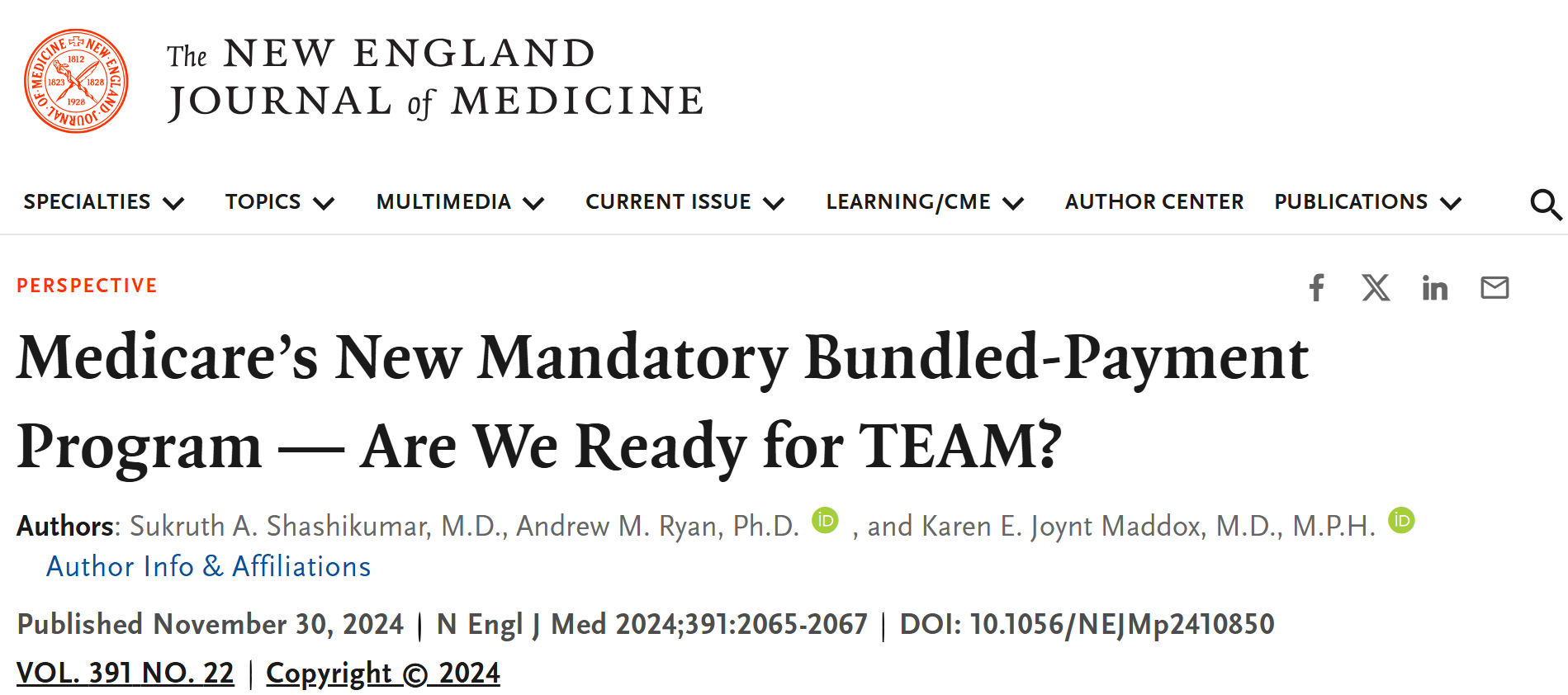
I found this NEJM perspective article really interesting and want to make a few comments on it.
The background for this new bundled payments initiative is that CMS has been trying out bundled payments in a voluntary capacity for a while, and they have lowered costs only slightly but paid out a lot more than that in bonuses.
If I keep talking about how important bundled payments are, does that mean this is evidence against what I’ve been saying?
That’s an important question. We tend to subconsciously ignore or justify or minimize or forget information that is dissonant with our worldview, so it’s something I have to be deliberate about avoiding.
And, in this case at least, these data fit exactly with what my Healthcare Incentives Framework would predict.
The only way to sustainably improve the value delivered by our healthcare system is by increasing value-sensitive decisions, which will enable higher-value providers and insurers to win more market power, which translates into more profit.
And bundled payments don’t achieve that by themselves.
For a value-sensitive decision to be made, you need patients to have (1) multiple options, (2) both the price up front and also some information about quality, and (3) they have to pay a little more if they choose a more-expensive provider or less if they choose a less-expansive provider.
So, no, I wouldn’t expect bundled payments to have a big impact immediately and in isolation. But they’re a super important piece of the solution to start integrating permanently into our healthcare system, so I hope CMS keeps up these efforts regardless of the short-term costs and benefits of these programs!
And one last point on the mandatory nature of this new bundled payment program, which is called the Transforming Episode Accountability Model (TEAM). (Man that’s a name that clearly started with the acronym.) I am not totally convinced that mandating hospitals to join a program is a good thing, but it may offer a track to solving one of the other challenges providers always face when they join alternative payment models: non-uniform incentives.
When a provider is rewarded differently from each payer, they don’t have the uniform incentives necessary to really optimize toward any single set of incentives. So even better than mandatory participation in a single bundled payment model would be to get all the insurers together in a region and have them all offer the same model to the providers, and then they have the choice whether to join or not.
And if you could also get the providers to report useful quality metrics and get the insurers to implement some differential cost-sharing requirements for those same care episodes, you’d be well on your way to seeing a region’s value start to dramatically shift upward for those specific services.
Basically, I’m describing the pilot program I designed for Utah as an intern at the Department of Health, but our grant proposal didn’t get funded. That was a heartbreaker. I do think that Departments of Health have a role here as a convener of these various parties to help them solve some collective action problems (in this case, getting uniform incentives for providers when implementing alternative payment models).
These sort of changes are so implementable if only the people running CMS knew about them.
Oh, and for those who have been following this blog for a while, here’s a quick update: I’m still working on revising my Theory of Money series. You’ll know it’s done when I release the summary post that gives an overview of each part in the series.


 Clear Thinking on Healthcare