Exactly Why Government Interventions in Markets Are (Almost Always) Super Destructive

Have you noticed the trend I’ve noticed about what people do when they become aware of some issue with an economy? It’s super predictable once you become aware of it. They jump from “there’s this issue with the economy” straight to “government needs to intervene to solve it.” And then they proceed to advocate for some kind of government regulation over how the economy works.

This post was spurred by watching this YouTube video (“You’ve Been Lied to About Food Prices”) by the truly excellent journalist, Johnny Harris. He talks about several reasons food prices have gone up lately. One of those reasons is the far-flung supply chains that make us so interdependent that any human conflict or natural disaster will have price-increasing reverberations throughout the world economy.

Then he talks specifically about egg prices. He revealed an important (and new-to-me) insight: The bird flu story was leveraged as a consumer manipulation strategy to justify higher egg prices.

But that doesn’t fully make sense unless all companies in the egg industry are colluding, either explicitly or tacitly, and using the bird flu story as a cover. Because otherwise any company that tries to raise their prices based on this bird flu-induced supply shock narrative will just lose market share to competitors who are willing to continue to sell eggs at the prior price and, thereby, win new customers.

Sure, I guess the bird flu story could influence price negotiations to give the egg sellers a little bit more leverage across the board. But still, any egg seller trying to raise prices will, at least in the medium or long term, lose customers when other egg sellers defect from the collusion (as is their incentive) to win market share and greater profit.

Anyway, the sadly predictable next step in Johnny’s logic flow–after talking about all these reasons why food companies are jacking up prices and making more profits–is to look to government to intervene. Those government interventions usually boil down to controlling prices or dictating supply in some other way. Sometimes governments even do the equivalent of controlling demand simply by regulating away options from the market, thereby neutering certain aspects of demand.

This is the predictable next suggestion that almost every person makes if they espouse the modern idea about governments that they are tools to be used for good in society wherever they can. But even people who don’t espouse that government-as-the-everything-tool idea, such as “anti-big-government” conservatives, make very similar suggestions (albeit couched in different wording that appeals to a different political tribe). Regardless of which political tribe a politician (or journalist) is in, they all tend to propose using government interventions to fix problems in the free market.

So, after discussing food prices, Johnny describes solutions, all of which rely on government interventions in some way. He even details in a pretty positive light the price controls the Mexican government instituted and how they have benefited Mexicans.

I don’t know why a fundamental misunderstanding of how capitalism works has crept into the political tribes all over the world, but I suspect one reason is simply that people don’t understand economics. That ignorance isn’t new, but it was prevented from becoming a problem during the cold war years when anything that even slightly resembled communism (and, to some extent, socialism) was firmly rejected. And now that communism is no longer the cultural villain it once was (as the culture of the boomers loses its cultural influence), the same ideas about government intervening in markets are much more accepted. This may explain why the likely soon-to-be mayor of New York City, Zohran Mamdani, is an avowed socialist who talks, among other things, about heavily taxing the wealthy, providing government-run (municipally owned) grocery stores with government-dictated prices, creating new rent price controls, and increasing the minimum wage to $30/hour by 2030.

For the rest of this article, I will do my best to explain specifically why these uses of government in the economy are so destructive and why they always, sooner or later, achieve the opposite of their intended effect.

To do that, I’m basically going to re-write Friedrich Hayek’s seminal essay, The Use of Knowledge in Society, published in 1945, which definitively and eloquently explains the foolhardiness and sheer potential destructiveness of attempts to use government market interventions to solve economic problems. Hopefully my rendition of his essay will be easier to understand for the modern human but will still convey clearly and persuasively the main insights. I’ll definitely leave out several sections that are ancillary points not relevant to a modern audience. But I’ll also quote him heavily because there are sections of that essay that are so beautifully and articulately written that I can’t help but quote them in full. Let’s get into it . . .

Our goal, from an economic perspective, is to construct a “rational economic order,” which I would interpret as an economy that works at maximum efficiency and produces exactly the goods that consumers want. This is logically achievable if we can possess all the information requisite to do that, which includes all details about the means of production and consumer preferences. Mathematically, the optimal answer is arrived at when the marginal rates of substitution between every commodity is the same.

This is mathematically solvable . . . but, the problem is, our true challenge lies in acquiring the societal knowledge necessary to solve the problem because “the ‘data’ from which the economic calculus starts are never for the whole society ‘given’ to a single mind . . . and can never be so given.”

I said some parts of this essay are so beautifully written that I need to quote them in full, and this is one such part: “The peculiar character of the problem of a rational economic order is determined precisely by the fact that the knowledge of the circumstances of which we must make use never exists in concentrated or integrated form but solely as the dispersed bits of incomplete and frequently contradictory knowledge which all the separate individuals possess.”

So, in summary, if we are to construct a rational economic order, the challenge lies in obtaining the data from which it can be calculated because those data (or, “knowledge,” as Hayek terms it) are “not given to anyone in its totality.”

Economists of Hayek’s day seem to have gotten lost in the weeds of mathematics and missed this main point that they can never use mathematics to solve a problem for which they don’t have the necessary input data.

Before we get into more details about how and why those input data (“knowledge”) are dispersed and so hard to obtain, let’s first clarify the definition of a term that we will be using frequently in that discussion: “planning.”

Planning in an economy happens whenever people are somehow collaborating to organize economic activity. Hayek defines his use of the term as “the complex of interrelated decisions about the allocation of our available resources.”

So while this isn’t a modern way of talking about “planning” in an economy, Hayek is making the point that an economy requires planning of some kind for it to achieve the goals of efficiency and suitability to consumer preferences. As you’ll see, he’s using the term “planning” to broadly include any person or mechanism that serves to coordinate those “complex and interrelated decisions.”

Now, since the knowledge a planner would require starts out as dispersed–and the reasons for the dispersed nature of that knowledge will be explained shortly–first that knowledge would have to be conveyed to the planner in some way.

Thus, having one central authority for the whole economic system (a central planner) would be pretty difficult because that’s a lot of information to receive and process and then a lot of instructions to convey once the planner has formed their conclusions. Alternatively, then, the task of planning could be divided among many individual planners (decentralized planning). The option that can be expected to be most efficient is whichever one will most completely obtain existing knowledge and then rapidly put it to use.

This leads to a discussion about specific different types of knowledge that will be required for the planner(s) to have and use.

First, there is scientific knowledge. If this were the only type of knowledge, a body of suitably chosen scientists could do a great job planning the economy. But, unfortunately, there are other kinds of knowledge that also need to be integrated into the economic plan. The second type of knowledge is what Hayek calls “the knowledge of the particular circumstances of time and place.” And this is the knowledge type that “practically every individual has some advantage over all others because he possesses unique information of which beneficial use might be made, but of which use can be made only if the decisions depending on it are left to him or are made with his active cooperation.”

To illustrate this second kind of knowledge (which I guess we could call “non-scientific knowledge”), think of a factory manager. Any given factory has a wide range of potential output efficiencies, and it’s up to the factory manager to achieve the highest efficiency possible, generally through, as author James Clear puts it, “the accumulation of marginal gains.” This factory manager has an incredible amount of knowledge to help him with this task, including which of his workers would be best suited to specific tasks, which of his machines are not being put to their full potential output, which processes could be adjusted to take better advantage of his workers’ and machines’ capabilities, which local conditions and circumstances will help get the most out of his employees, etc.

Another illustration of the relevance of this non-scientific knowledge in the task of planning an efficient economy is someone who has worked in various parts of the shipping industry and has become aware of a potential business opportunity after observing that most shipping containers have unused weight and space capacity. Not only does this person have the understanding of the typical shipping lanes through which the right kind of products are flowing that could be added to fill the excess shipping container capacity, but they have the human connections necessary to talk to the right people at both ends of a route and make that business idea become a reality.

Let me make explicit a really important point from those two illustrations: Every time someone makes use of this non-scientific knowledge to generate profits for a business, they are performing an “eminently useful” function by capitalizing on their “special knowledge of circumstances of the fleeting moment not known to others.” Essentially, they are extracting every bit of inefficiency out of the economy, and the profit their company receives as a result of that effort is a small price to pay for the added economic efficiency.

Hayek then speculates on why this non-scientific knowledge’s importance is underappreciated in his day. I don’t have to review the specific details of his musings on that, but he saw it as one more factor that was pushing his contemporary economists toward believing that central planning could adequately achieve a rational economic order. This is a running theme of the essay–Hayek was not only trying to provide insight into how best to achieve a rational economic order, but also he was trying to provide insight into the barriers to understanding these insights that many of his contemporaries faced. Most of those barriers addressed by Hayek in his essay no longer apply to today, but I think getting to the core of what factors are perpetuating economic ignorance today is something worth working on since it’s probably the root of most misguided and economically harmful policy proposals (and their support).

Next, we have to discuss a specific characteristic of those two types of knowledge that a planner needs that we haven’t explicitly addressed yet: change.

The ever-changing nature of scientific and non-scientific knowledge is what makes the task of a planner orders of magnitude more formidable. “Economic problems arise always and only in consequence of change. So long as things continue as before, or at least as they were expected to, there arise no new problems requiring a decision, no need to form a new plan.” I believe this characteristic of knowledge is even more significant than it was in 1945 due to the ever-increasing rate of economic change through more and more advanced technology that allows even faster rates of change.

This ever-changing nature of knowledge explains why you can’t just build a factory and, thereafter, assume “the rest is all more or less mechanical, determined by the character of the plant, and leaving little to be changed.”

Hayek doesn’t have a high opinion of his contemporary economists’ understanding of this point, and he suspects that it’s because they lack “the practical experience of the businessman.” They’ve never seen how much effort and skill and constant struggle is required on the part of a manager to optimize the profitability of a factory, taking into account not only the scientific and non-scientific knowledge they are privy to, but also given the ever-changing nature of that knowledge that requires weekly, daily, and maybe even hourly pivots. I love the section in Hayek’s essay that explains this point further: “The continuous flow of goods and services is maintained by constant deliberate adjustments, by new dispositions made every day in the light of circumstances not known the day before, by B stepping in at once when A fails to deliver. Even the large and highly mechanized plant keeps going largely because of an environment upon which it can draw for all sorts of unexpected needs; tiles for its roof, stationery for its forms, and all the thousand and one kinds of equipment in which it cannot be self-contained and which the plans for the operation of the plant require to be readily available in the market.”

And now let’s add one more challenge to the planner’s effort to obtain this knowledge. Hayek writes, “The sort of knowledge with which I have been concerned is knowledge of the kind which by its nature cannot enter into statistics and therefore cannot be conveyed to any central authority in statistical form. The statistics which such a central authority would have to use would have to be arrived at precisely by abstracting from minor differences between the things, by lumping together, as resources of one kind, items which differ as regards location, quality, and other particulars, in a way which may be very significant for the specific decision. It follows from this that central planning based on statistical information by its nature cannot take direct account of these circumstances of time and place and that the central planner will have to find some way or other in which the decisions depending on them can be left to the ‘man on the spot.'”

To illustrate that last point, think of his example of the factory needing new roof tiles. This isn’t something a central planner is ever going to be able to anticipate (“which by its nature cannot enter into statistics”) because it’s unknown how long the specific tiles used on the factory’s roof will last. They could guess, based on historical information about how long tiles typically last, how many tiles should be sent to each factory with those specific roof tiles, but odds are incredibly high that they’ll be stacked up and unused (along with a million other random supplies) and lost in some part of the factory. Or they’ll be taking up some crucial storage space and finally someone will decide to just move them outside, where they degrade and crack. So now we have an inefficiency in the economy because tiles are getting wasted and cumbering limited space. Or, the alternative scenario is that those original tiles were faulty, so tons of new ones are needed, and pretty soon the manager realizes he needs to just get a completely new roof or find a new kind of tile to retro-fit the existing roof and expect to replace more of the old faulty ones on a daily basis. And since those needs never could have been anticipated, the factory gets a leaky roof while new tile requests are sent up to the planners, creating a big delay, and worsening working conditions in the meantime, maybe even triggering workplace exposures like mold inhalation that could cause headaches and decreased worker efficiency. And machines could get dripped on and rust out earlier than expected, which causes an unanticipated shortage of whatever the factory was making, and so forth, until the reverberations of inefficiency from a simple tile defect and shortage continue to spread throughout the entire economy.

As an aside, people sometimes wonder why the United States fared so well after WWII and the U.S.S.R. did not. This is what central economic planning gets you–innumerable little inefficiencies that lead to more inefficiencies that lead to even greater challenges with central planning, until ultimately the system collapses and reverts back to a form of decentralized planning that actually works really well (we’re getting there). This is why they had to build a wall to keep East Germans in–because the economy of East Germany was so inefficient due to central planning that the country was in deep poverty compared to right across the wall in West Germany, so people wanted to get out. It’s the same with North Korea and its extensive walls today–they’re primarily to keep people in rather than to keep people out.

Anyway, the foolhardiness of attempting any form of central planning should be clear by now; there’s no way to obtain all the requisite information, and even if all that information could be obtained, there’s no way to integrate it and communicate optimal answers in a timely way to each possible question that arises about how best to use limited resources. Thus, a decentralized planning mechanism is obviously much better.

So how well would relying on decentralized humans do? It would ensure that the local non-scientific knowledge (“knowledge of the particular circumstances of time and place”) could be promptly used, but the problem remains of “communicating to him such further information as he needs to fit his decisions into the whole pattern of changes of the larger economic system.” In other words, how would we coordinate the decisions of all those decentralized planners? How would the tile designers and the tile factory quickly become aware of the needs of a new retrofit tile across the country, and how would the clay supplier be notified that they need to start shifting their harvesting efforts to a different clay composition, etc.? Economies are so interdependent that, to fully coordinate the decisions between all of those planners, you would need them to be making decisions that optimally integrate with the entire world economy. In Hayek’s words, “There is hardly anything that happens anywhere in the world that might not have an effect on the decision [each decentralized planner] ought to make.” Obviously, the conclusion here is that even decentralized planners would be woefully inadequate.

Is there a better alternative? Yes. We already know that we need each individual to be making their own decisions about how to focus their limited resources to optimally respond to their own situation, but we’re still left with the question of how to coordinate their choices with the rest of the millions or billions of individuals doing the same thing.

Fortunately, to accomplish that coordination, the “man on the spot” decision maker doesn’t need to know all the details of every aspect of the world economy to be able to coordinate his decisions with it. “It does not matter for him why at the particular moment more screws of one size than of another are wanted, why paper bags are more readily available than canvas bags, or why skilled labor, or particular machine tools, have for the moment become more difficult to obtain. All that is significant for him is how much more or less difficult to procure they have become compared with other things with which he is also concerned, or how much more or less urgently wanted are the alternative things he produces or uses. It is always a question of the relative importance of the particular things with which he is concerned, and the causes which alter their relative importance are of no interest to him beyond the effect on those concrete things of his own environment.”

And this, finally, brings us to the solution of how to help every individual involved in an economy (every “man on the spot”) to coordinate their efforts with everyone else: prices. They are a form of constantly updated “equivalence” or “marginal rates of substitution.” In other words, they’re a means of “attaching to each kind of scarce resource a numerical index which cannot be derived from any property possessed by that particular thing, but which reflects, or in which is condensed, its significance in view of the whole [economy].”

How amazing is that? I suspect most people in the world today take prices for granted. They have no idea that each individual price is essentially a summation of billions of tiny pieces of knowledge that reside in the minds of millions or billions of different people. They have no idea that prices are an incredibly efficient (and simple!) means of solving the most intractable problem modern economies have, which is that of coordinating every single aspect of an economy to operate in an efficiency-optimizing way, all while taking into account the individual preferences of every single human that is even remotely connected to that economy. In short, prices are the core of how we construct a “rational economic order.”

Think about it in a more personal way. Whenever you make a choice, at home or at work, about how you will spend your/your employer’s limited resources, you are taking into account your preferences and needs and then determining, consciously or not, which option will be the highest-value one to meet your needs. In other words, your preferences (condensed into your estimation of the “quality” of a thing) and the price are coming together to help you make an optimal value choice for yourself, and that decision is then reflected in future pricing to be integrated into the entire world economy.

Prices are never perfect, of course. They lag behind individual decisions a little bit and sometimes a lot. They are sometimes skewed by irrational (non-self-optimizing) decisions that humans are so susceptible to making. They can be messed up by companies exploiting consumers. And so forth. But these are only issues in the short and medium time horizons. In the long run–in the absence of government interventions that can cause market imperfections to persist indefinitely–prices always tend toward their optimal value to help create a rational economic order. Even issues like monopoly pricing (either from an actual monopoly or from a group of companies acting as a monopoly through collusion) are self-correcting because of the price system. Monopoly prices are higher than would otherwise be optimal, which leads to excess profits being reaped in that industry, which motivates new entrants or, if new entrants are locked out, disruptive innovations that fulfill the same job for consumers but in a different and higher-value way. So even something like the natural monopoly of a fibre optic internet provider who was the only one to lay cable when a community was being built and is charging monopoly prices to that community for high-speed internet will eventually have their power to continue to do monopoly pricing disrupted by newer technologies such as cellular or satellite internet.

So, yes, prices are imperfect. Really, the only way to craft a perfectly rational economic order is to have an omniscient god who is also able to simultaneously communicate to each individual person the optimal use for limited resources in every instance. But, until an omniscient god comes around and starts telling us what to do in every instance, we are left with the imperfect price system.

If you could compare the efficiency of the price system to the omniscient god system, I suspect it would perform just ok. But compare the efficiency of the price system to any other system we currently have available, and the difference in efficiency is vast. I already talked about the U.S. versus U.S.S.R., as one example. And the rest of the article up to this point serves to drive home the specific mechanics of why the price system is so much better than any form of human-generated planning, whether it’s centralized in a single planning authority or decentralized into many separate local planning authorities.

Finally, Hayek gives a specific example of how powerful prices are at helping coordinate and optimize the activities of the entire economy. Here it is in full:

“It is worth contemplating for a moment a very simple and commonplace instance of the action of the price system to see what precisely it accomplishes. Assume that somewhere in the world a new opportunity for the use of some raw material, say, tin, has arisen, or that one of the sources of supply of tin has been eliminated. It does not matter for our purpose—and it is very significant that it does not matter—which of these two causes has made tin more scarce. All that the users of tin need to know is that some of the tin they used to consume is now more profitably employed elsewhere and that, in consequence, they must economize tin. There is no need for the great majority of them even to know where the more urgent need has arisen, or in favor of what other needs they ought to husband the supply. If only some of them know directly of the new demand, and switch resources over to it, and if the people who are aware of the new gap thus created in turn fill it from still other sources, the effect will rapidly spread throughout the whole economic system and influence not only all the uses of tin but also those of its substitutes and the substitutes of these substitutes, the supply of all the things made of tin, and their substitutes, and so on; and all his without the great majority of those instrumental in bringing about these substitutions knowing anything at all about the original cause of these changes. The whole acts as one market, not because any of its members survey the whole field, but because their limited individual fields of vision sufficiently overlap so that through many intermediaries the relevant information is communicated to all. The mere fact that there is one price for any commodity—or rather that local prices are connected in a manner determined by the cost of transport, etc.—brings about the solution which (it is just conceptually possible) might have been arrived at by one single mind possessing all the information which is in fact dispersed among all the people involved in the process.”

Hayek then says that the most significant fact about this price system is “the economy of knowledge which which it operates, or how little the individual participants need to know in order to be able to take the right action.” This truly is incredible. Through a single metric–a price–a consumer’s individual decisions are coordinated with the rest of the economy. And when any change occurs in any market, such as the scarcity of a one raw material, what happens as a result of that price changing? “Without an order being issued, without more than perhaps a handful of people knowing the cause, tens of thousands of people whose identity could not be ascertained by months of investigation, are made to use the material or its products more sparingly; i.e., they move in the right direction.” Hayek calls it a “marvel” and says that, if the price system had been the product of human design, it would be “acclaimed as one of the greatest triumphs of the human mind.”

Now think about the aggregate effects over time from humans stumbling upon this price system. It, in essence, allows people to coordinate in ways that would otherwise be impossible to them. And this coordination is what allows us to rely on each other’s knowledge to such an extent that humanity has been able to develop an almost unfathomable amount of division of labor and specialization, all of which is the driver of innovation. In short, our entire modern civilization is built upon the benefits that the price system has conferred.

The rest of Hayek’s essay is interesting but doesn’t add anything to the main points presented above, so this concludes my re-writing of his essay. I definitely encourage you to read it in full yourself to fully appreciate its majesty.

Now let’s go back to where we started. I hope you have a better understanding of why I have a particularly strong revulsion to any proposal for government economic interventions made in response to a perceived issue in the economy, including those that were discussed in the Johnny Harris video. Those government “solutions” almost always involve central planning in some form; in other words, they almost always disrupt the price system in some way. And the ensuing market inefficiencies destroy a huge amount of the future wealth-generating potential of the economy, leading to relative poverty in the future, which usually results in further and more extensive foolhardy attempts to manage the economy through government intervention, and the downward spiral continues.

Hayek’s insights from this essay are foundational to my solution to our terribly inefficient healthcare system, and they also shed light onto why the price distortions from fiat currencies (explained in my Theory of Money series) are so damaging to an economy. This also further explains why the U.S. became a world healthcare spending outlier. All of these modern issues are, in a major way, connected to and directly arising from government-instigated problems with prices (i.e., government interference with the price system).

I will conclude with a personal note. I spend a lot of time and effort thinking about and writing about these issues (although more of my content is on X these days–it seems that blogs are less relevant than they used to be). I spend all of that time and effort not because this is my day job. In fact, I don’t earn any money from this work. But I keep doing it because my motivation is to impact society for the better; I want more people to understand the principles that underlie good government and economic systems. Because my belief is that if more people understand a good policy when they see one, they will be more likely to support it, which results in good policies becoming more likely to be enacted. And that will result in greater prosperity and happiness for humans. But often my motivation to improve society, and the time I spend on this endeavor, feels like a burden, especially when (1) I am so busy already with work and raising children and personal development (2) it seems that my efforts are not yielding the benefits I so strongly desire. I’m not sure what to do about all of that. It leads me to sometimes question, What’s the point of it all? I still don’t have an answer to that. Maybe I need to look into finding a way to profit from this work, which would probably require a huge increase in the time I dedicate and is unlikely to earn me as much as working extra shifts at the hospital. Plus I don’t know how I feel about a profit motive potentially tainting my incentives. Maybe I eventually just need to get into politics and try to make a difference more directly. But, until I figure any of that out, I hope this post at least helps some people out there learn something new. I hope it has helped you understand the importance of not messing with prices (directly or indirectly) and re-align your policy preferences accordingly. If it has helped you, drop me a line. Or if you have ideas of how to expand my reach and impact, also drop me a line. I just want to be helpful, and I’m not ready to give up on that just yet in spite of the burden it puts on my life.

Mars Constitution

Last update: June 6, 2025

Originally ratified: N/a

Last amended: N/a

PART I: PRINCIPLES

Article 1: Purpose of a Constitution

A principle is a universal truth and is always applicable, although there can sometimes be a higher principle that supersedes it in a particular situation.

A rule is an attempt to operationalize the applicable principles to a specific situation. Rules can never account for every aspect of a given situation, which is why they always have exceptions. Thus, rules need to be changed from time to time as better ways to operationalize the applicable principles are discovered and as situations change. This is why the Rules section of this constitution must always have a lower threshold for amendment compared to the Principles section.

Progress consists of learning the lessons of the past and then building upon them. Just as this is the source of technological progress, it is also the source of social progress.

A primary means of achieving social progress is improving the form of governance. This is because a government provides structure to the culture of a society, and culture shapes the behaviours of individuals.

The organization of and limits on a government are specified by a constitution. Therefore, to achieve and then maintain an optimal government, an optimal constitution–which codifies the lessons of the past and allows for amendment to codify the lessons of the future–must first be established. This is an attempt to create just such a constitution. For simplicity, all amendments shall be integrated directly into their applicable sections rather than be compiled at the end. But for the sake of tracking changes, prior versions shall be archived and accessible.

Historically, the perception of government shifts over generations. It starts out as a necessary evil established only for a few specific purposes, but that hesitance and mistrust eventually morph into thinking of it as a tool to be used on every problem in society, which then justifies perpetual government expansion. Along with that expansion in size and scope comes increasing power, which leads to accumulating restrictions on individual liberties until, eventually, the populace resorts to revolution or escape, and then the multi-generation cycle begins anew.

In an effort to break that cycle of government expansion and revolution, a primary challenge this constitution faces is to preserve the government status as one that is only empowered to perform a small number of specifically enumerated functions and prevent perpetual expansion. Therefore, the government shall have no power to act, directly or indirectly, on issues or in ways not specifically enumerated in this constitution. Moreover, if society and/or technology change in a way that eventually requires less government involvement to achieve the principles outlined herein, then the government functions should be reduced accordingly.

Article 2: Goals of This Constitution

Social progress is defined here as achieving more completely a society that (1) maximizes individual liberty, (2) achieves equality under the law, and (3) encourages positive-sum behaviours.

Maximizing individual liberty: Different kinds of liberty can conflict with each other, which means that all forms of liberty cannot be maximized at the same time. The form of liberty prioritized here is “negative liberty,” which is herein defined as freedom from all forms of unnecessary coercion in individuals’ lives. This includes all possible sources of coercion, including from governments, non-government organizations, and from other individuals.

Achieving equality under the law: Different laws can apply to different citizenship classes (adult citizen, minor citizen, non-citizen, etc.). However, every member of a citizenship class must be treated equally under the laws that apply to that citizenship class. Only from such equal treatment under the law can a society of merit thrive.

Encouraging positive-sum behaviours: Selfishness and exploitation of others are the great enemies to positive-sum behaviours. Selfishness is defined as making a decision in one’s self-interest without considering the impact of that decision on others. This is an internal process and cannot be known or judged by others. Exploitation, on the other hand, is an external behaviour that involves the deception and/or manipulation of others, and it can be known and judged by others. Manipulation is herein defined as influencing another’s behaviours by inducing pain (physical or emotional) or fear of pain. Importantly, acting in one’s self-interest does not constitute a negative-sum behaviour unless it includes selfishness and/or exploitation.

In addition to these purposes, society must also be protected from outside threats to this order.

The design of government greatly affects the extent to which those goals are achieved in a society.

Article 3: Principles of Government Design

The primary values of government design are simplicity and transparency. Simplicity minimizes the direct and indirect costs incurred by government on society, and transparency minimizes the opportunities for corruption.

Transparency is also essential to democracy because a government that is not transparent is not accountable to the people. In other words, a non-transparent democracy is a sham democracy. The government shall continuously work toward radical transparency, making all government-related information immediately and publicly available as well as easily accessible and interpretable with the goal to help all interested members of society be fully aware of what the government is doing. Rare exceptions to this are possible, although the motivation for keeping any information confidential shall never be to protect an individual’s reputation or to prevent public fear or outcry or to protect society at large or any group within society from possible harm or any kind.

Historically, another challenge that all government workers–elected, appointed, or hired–face in their efforts to achieve the above-stated goals is bias and bribery. A major driver for bias and bribery arose naturally primarily because political campaigns are expensive and job security as a government worker is always uncertain, so individuals and organizations filled those needs by providing financial and non-financial benefits to government workers but usually with implied or overt strings attached. Even without implied or overt strings, the nature of biases is that they are invisible to the one who has them, and receiving such benefits biases an individual toward the source of those benefits. Thus, any financial or non-financial benefit to a current or aspiring government worker, including future promises of such benefits, provided with the probable intent to influence government workers’ decisions in their employment, are prohibited. Transparency will mitigate such issues, but the government shall also actively work to minimize the costs of political campaigns.

All government actions can be attributed to one or more of five spectra:

1. Political spectrum: Who makes the laws.

     Autocracy <———-> Direct democracy

  • Direct democracy, inasmuch as is practical (depending on the number and complexity of issues to be voted on), is preferred for the sake of transparency. For situations where direct voting is not practical, democratically elected representatives will be needed.
  • Selection of representatives must be determined by some form of majority voting system or proportional voting system rather than a plurality voting system, which causes unrepresentative outcomes, wasted votes, and tends to polarize society into two political tribes. A proportional voting system that also allows for direct candidate selection without candidates being assigned to any one district is preferred because it allows for greater control over candidate selection by the people and minimizes the incentive for district-preferential behaviours (e.g., earmarks) in elected representatives. Elections shall be held for all positions according to a regular schedule and shall not be delayed for any reason. Newly elected individuals shall replace their predecessors within a predetermined standard timeline, which shall be as soon as is practical.
  • Governments are traditionally inefficient compared to the private sector because they are not subject to market forces, which punish inefficiency. But, through federalism, a form of competition between governments operating on the same level but with different stewardship areas can be created. Therefore, federalism, with a minimum of two levels of government and a maximum of as many levels as is deemed necessary, shall be used. Fewer levels allows for greater simplicity; more levels allows for greater granularity in the distribution of power. Decision-making authority on any issue shall be pushed down to the lowest level of government that is reasonable because people closer to an issue are in a better position to satisfactorily solve that issue.
  • Election integrity is crucial to the stability of a democracy. At all levels of government, voting on any issue shall take place on a single day, and means of increasing general engagement (i.e., voter turnout), especially by removing barriers to voting, shall be sought. Vote counting and result reporting shall be done transparently and only after the voting window has closed.

2. Legal spectrum: How much the laws are spelled out beforehand, and how consistently they are applied.

     Rule of man <———-> Rule of law

  • The rule of law, with punishments assigned according to the severity of the crime and uniform enforcement on all individuals within each citizenship class, must be prioritized.
  • However, an overly detailed set of laws can become burdensome, so this must be balanced with the need for simplicity. Relatedly, the rule of law must not become legalistic; it must recognize that there are exceptions to every law, and in cases where an individual’s behaviours break the law for the sake of adhering to the higher principles that apply to the situation, that should be taken into account. Legal decisions shall be public knowledge, which provides a social incentive for individuals to refrain from breaking the law.
  • All laws shall be assumed to apply to all citizenship classes unless otherwise specified. Citizenship classes exist for the sake of affording different legal requirements and privileges to individuals on the basis only of whether they have attained their age of majority and their permanence of living in the society. Each individual can only be assigned to one citizenship class at any given time. The age of majority shall be determined on the basis of the age at which a typical individual has achieved the capacity to meaningfully contribute to political affairs. Voting rights shall be restricted to full citizens.

3. Economic spectrum: Locus of decision making about the distribution and use of resources.

     Centralized (planned economy) <———-> Decentralized (capitalism)

  • Decentralized decision making shall be utilized as much as possible. Prices shall only be set by the market. Government price setting in any form shall not take place. This includes tampering with the value of money and also interest rates. No fiat money or fractional reserve banking shall be allowed. No form of money that the government can directly monitor shall be allowed. The only permissible form of money shall be specie or 100% backed receipt money (including electronic forms of receipt money). The form of specie used may not be specified by the government; instead, the free market will be allowed to determine this.
  • The foundation of capitalism is private property rights, which shall be protected. Government ownership shall be nonexistent except for the minimum number of assets necessary to perform its functions and whatever investments it owns in its emergency fund. Whenever a transparent and competitive contracting process with private entities can be efficiently and effectively used to outsource government tasks to the private sector, this is preferable.
  • Intrasociety trade, transportation, and relocation shall always be unrestricted. No tariffs, quotas, or other instruments that interfere with intrasociety free trade shall be used.
  • The government shall have the power to regulate trade with parties outside the society. The goal shall always be free trade. Negotiation tactics to encourage free trade, such as reciprocal tariffs promised only as a response to the trading partner establishing or continuing any impediment to free trade, are allowed.

4. Welfare spectrum: Degree of wealth redistribution.

     Zero <———-> Full

  • Active forms of government wealth redistribution involve taxation for the sake of redistributing that wealth to the poor. Passive forms of government wealth redistribution involve lower tax rates for the poor. Passive forms of government wealth redistribution are preferred over active forms of government wealth redistribution due to the issues inherent in government-run active wealth redistribution programs, such as system exploitation (by organizations receiving and disseminating the money and also by the individuals receiving that money), behavioural distortions, and social and political frictions. Private solutions to the social issues that arise from wealth disparities are preferred over active forms of government wealth redistribution.

5. Liberty spectrum: Degree of freedom from coercion.

     Zero <———-> Full

  • Laws and regulations induce complexity, which create incalculable burdens on society. Historically, these burdens accumulate over time and cause older societies to calcify, thus interfering with social and economic progress. Therefore, new laws and regulations must be kept to a minimum, and antiquated laws and regulations must be proactively removed. Loopholes in laws and regulations that allow for legal violations to the applicable principles shall be proactively closed.
  • The primary goals for laws and regulations shall be to prevent exploitation and unnecessary coercion, both of which are defined above, and also to mitigate free market failures. Free market failures can be seen from the industry side and the customer side. On the industry side, negative externalities, anticompetitive behaviour, and public goods are able to be addressed through government intervention. On the customer side, issues arise primarily in the form of customers being unable to make value-sensitive decisions, which are defined as purchase decisions made on the basis of ex ante quality and price data for each option. Therefore, government interventions that mitigate major barriers to value-sensitive decisions, while balancing the expected benefits with the risk of creating new barriers to progress, are allowed.
  • Freedom of speech, also known as freedom of thought and expression, is paramount. The government shall take no part in censoring or propaganda. All ideas and beliefs, including those considered to be the most repugnant according to cultural trends, will be allowed without restriction or repercussion, with the exception of harm to the reputation of individuals through deceptive communications. Tolerance is encouraged. Tolerance is herein defined as treating all individuals with respect and kindness regardless of the degree to which their beliefs differ from yours. Any suppression of alternative viewpoints will be considered authoritarian behaviour and shall be prohibited. Rather than silencing misinformation, the free market of ideas will be relied upon to eliminate falsehoods and reward ideas according to their merit.

There shall be a regularly scheduled complete review of all laws, with an aggressive effort to remove any that are no longer considered to be essential. For any law to remain, its realized benefit must be substantial enough to offset its guaranteed costs to society, which include increased complexity, increased compliance and enforcement burden, and potentially hindered progress.

Article 4: Government Funding

Governments are typically able to raise money through five primary methods: various forms of taxation, borrowing (which is deferred taxation), printing fiat money (which is a hidden form of indirect taxation), through profitable investment, and through trade fees (such as tariffs).

Taxation: No form of indirect taxation shall be used. This is because taxpayers need to clearly see exactly how much money they are giving to the government, which helps them assess the costs of government functions more rationally. Regarding direct forms of taxation, each additional form of direct taxation used imposes further complexity burdens and economic distortions on society, so relying on a single form of direct taxation is encouraged. No tax exemptions or rebates of any kind shall be given with the exception of a personal exemption, which shall be the same for all individuals regardless of citizenship class.

Borrowing: Unless constitutionally prevented, government debt burdens tend to accumulate due to the unpopularity of raising taxes and the collusion between occasionally short-sighted societies and politicians’ typically short-term incentives. Therefore, no government borrowing of any form of wealth will be allowed. This includes creative forms of borrowing, such as early tax payments in return for a promise of future benefits.

  • The prohibition of government wealth borrowing creates a possible issue. If government spending needs to be significantly increased due to some emergency that the government has been empowered to address (such as war), the government will not have adequate funds to properly manage that emergency. Therefore, a government saving requirement will be in force. The government shall save a reasonable portion of its income every year until it has saved up an emergency fund deemed of adequate size to finance the management of any likely emergencies. This emergency fund shall be saved in the form of specie and investments. Investments are required to be broadly and substantially equally diversified to minimize the risk for the government giving investment-based preferential treatment to certain enterprises or sectors. Once that emergency fund has achieved its predetermined size, that saving requirement will become dormant until the emergency fund has again dropped below its predetermined size.
  • A potential benefit of such a policy is that investment income from that emergency fund may be used to cover government expenditures. This should not be an excuse to increase government spending but rather to decrease taxation. If that investment income is of sufficient size, it may be able to offset all tax liabilities and the government may continue to run in perpetuity without further taxation. However, if an emergency requires spending down that emergency fund, then the saving requirement automatically reactivates, which would likely result in a resumption of taxation to facilitate building it back up to the predetermined size.

Printing fiat money: As already addressed above, this will not be possible because fiat money is prohibited.

Profitable investment: Government may own investments in its emergency fund, but it may not directly or indirectly manage any enterprise. Accordingly, any influence over any enterprise, including voting rights, acquired by government through investments shall be forfeit to the enterprise’s non-government owners (in accordance with the policies of the relevant enterprise).

Trade fees: As addressed above, the purpose of trade fees shall not be used for the sake of government income and shall solely be used only as needed for the sake of encouraging free trade.

Budgeting is a predictive process, and thus it is prone to errors.

Regarding the expense side, adequate government funds shall be allocated to each government function to ensure complete and proper implementation and complete and proper enforcement. The funding requirement shall be determined according to cost estimates generated by a nonpartisan government body that generates realistic and conservative estimates (i.e., tends toward overestimating costs).

Regarding the income side, taxes shall be adjusted according to predicted expenses for that fiscal year. In the event of an under-estimation, additional funds shall be taken from the emergency fund, and cost estimates for that government function for the next fiscal year shall be adjusted accordingly. Unused funds, when they occur in the context of adequate implementation and enforcement oversight, indicates unexpectedly efficient government operation, shall be deemed a success by the individuals responsible, and the unused funds shall be added to the emergency fund.

Article 5: Government Structure

The organization of this government shall be in the form of three branches, each of which shall have powers that act as checks on the power of the other two branches, with the purpose of them all enforcing each other’s actions to remain completely consistent with this constitution:

Legislative branch: The primary purpose of this branch is to manage the collection of laws that specify government functions. Historically, the perverse incentive for legislative branch politicians is to create more laws, especially those that benefit their district, because doing so wins them popularity and, thus, job security. That incentive system tends toward an ever-growing set of laws. To avoid that, this legislature shall only be activated when a problem arises that it is empowered to address. And a single-subject rule (requiring each law to only address one issue) shall always be in force, thus limiting riders (i.e., porkbarreling). Legislative branch members should also be rewarded not only for their efforts to quickly establish simple and fair laws that address societal problems but also for their efforts to improve society by identifying and proactively removing or amending laws that are no longer necessary or functioning optimally. A legislature that prevents the growth of government and even decreases its size shall be considered a success.

Executive branch: The primary purpose of this branch is to efficiently, effectively, and fairly execute the laws made by the legislative branch. This branch will always be active because the execution of the laws will be an ongoing task. The President, as the leader of this branch, has the authority to hire and fire at any time any individuals working in the executive branch.

Judicial branch: The primary purposes of this branch are (1) to review every law passed by the legislative branch and reject any law that is not in strict compliance with this constitution and (2) to monitor the executive branch’s efforts to execute those laws and enforce changes when the execution is not consistent with the law.

Article 6: Documenting Government Actions

There will be six documents that comprise all government documentation:

1. This constitution

2. Laws: All laws passed by the legislative branch will be required to be expiditiously enacted as positive law in a way that integrates them fully into the Laws document, after which the specific wording of the original laws passed will no longer hold any legal validity. Temporary/short-term laws may be integrated into a separately consolidated section of the Laws document, and they shall be automatically stricken from it once they expire.

3. Regulations: This document is managed by the executive branch, and it is created based on the Laws document to guide its day-to-day execution of the laws. Oversight to ensure proper compliance with the Regulations document will also be required. These regulations can be changed any time by executive branch leadership, as approved by the President, without legislative branch involvement, although they will be subject to review by the judicial branch to ensure appropriate execution of the existing laws.

4. Civil and criminal law: This is the accumulated interpretations of the how the Law should be appropriately applied to specific situations. Rather than rely on case law, legal decisions that rule on an area previously unaddressed will be flagged to be enacted as positive law, which will be overseen by elected legal experts.

5. Financial records: This includes details about government assets, the government budget, and actual income and expenditures. The government shall track and report these with sufficient detail to ensure clear and thorough understanding in every aspect of how it is performing in its role as a financial fiduciary.

6. A list of items kept confidential, and when they will be declassified: This is for the sake of transparency about what the government is keeping hidden from public information. The principles guiding what the government may keep confidential are outlined above.

Each level of government shall have its own set of documents that mirrors the structure of these six documents.

PART II: RULES (still very much a work in progress!)

Article 1: General Government Powers

In accordance with the above principles and goals, the core functions of government are here enumerated:

1. Provide a legal system, which includes three arms that correspond to the three branches of government: (1) the legislative arm, which involves the creation of laws, including dictating the consequences of breaking them, to establish the rule of law for arbitrating disagreements, enforcing contracts and property rights, and preventing the exploitation and unnecessary coercion of individuals; (2) the executive arm, which establishes a police force for the purpose of completely and uniformly enforcing the laws; and (3) the judicial arm, which establishes a court system for interpreting the law, according to the applicable principles of each situation, to resolve disputes.

2. Provide a national defense system to protect from foreign physical attacks.

3. Regulate trade with other societies.

Any problem outside the scope of these enumerated powers shall not be addressed by government; instead, they shall be left to individuals and non-governmental organizations who have the means and desire to address them.

Article 2: Legislative Branch

The legislative branch’s primary responsibility is to maintain the Laws document, including adding new laws as necessary and updating or removing existing laws. These laws shall only address the following issues:

  • Citizenship classes: For the purpose of determining the different citizenship classes and criteria for and process of making assignments, which shall be done expeditiously.
  • Taxation: The only form of taxation shall be through a flat percentage rate income tax on individuals with a personal exemption for each individual. The legislature shall determine the size of the personal exemption, the income tax percentage rate, and shall clarify how income will be tracked and reported. All forms of income shall be subject to this flat taxation with small exceptions, such as for personal gifts, that would be expensive and overly intrusive to monitor and enforce.
  • Disputes between individuals:
  • Enforcing contracts:
  • Exploitation:
  • Coercion:

The structure of the legislative branch shall be as follows: A minimum of 17 representatives and a maximum of 49 representatives, with the total number automatically adjusting within that range according to the following formula: number of citizens in society divided by 30,000, rounded to the nearest whole number. Each representative shall be elected to a 4-year term, with half of the representatives’ seats being assigned to be up for re-election every 2 years. Representatives may only serve for a total of 3 terms in their lifetime.

Elections: Elections shall be held every 2 years on the first Monday of the second month. Employers shall be required to allow their employees sufficient time to cast their votes on that day. Voting centers shall be numerous enough and dispersed in a way that minimizes the travel time of all potential voters. Ballots shall be cast in physical form to minimize voter fraud, and the transfer, tabulation, and reporting of votes shall be done publicly and immediately after ballots close. The transition of power shall take place at 8 a.m. two Mondays after the election.

Electoral voting system: The entire society is a single district, with the number of seats assigned in proportion to the percentage of votes for each party. Unaffiliated candidates are considered to be in their own party. Voters may choose their top three parties and their top three candidates from within each party. With a goal to allow voters to express their true preference without the concern that a vote for a potentially less popular party will be “wasted,” any vote for a party that does not get enough first-place votes to win a seat will be transferred to the second-place or, if necessary, third-place party. A similar system will be used to assign specific party members to seats according to the rankings assigned by voters.

Ability to remove activist judges?

Checks on the president’s power?

Who determines which issues will be put to a direct democracy vote? Need an incentive to do that, otherwise elected reps will be tempted to keep the power to themselves when it’s convenient for them and to put it to the people when they don’t want to be blamed for something.

Article 3: Executive Branch

The executive branch’s primary responsibility is to maintain the Regulations document for the sake of Initial list of possible things to address:

  • Trade deals
  • Declaring war
  • Which issues and proposed solutions shall be assigned to a direct vote by the people or to the legislature, or if the issue should be assigned to a lower level of government.
  • Maintain the list of items kept confidential?

Article 4: Judicial Branch

Initial list of possible things to address:

  • Overseeing the laws made by the legislative branch are constitutional
  • Overseeing the executive branch’s execution of the laws is consistent with the laws’ interpretation
  • Interpreting laws according to the applicable principles

Article 5: Federalism

Initial list of possible things to address:

  • Levels of government, which powers are delegated to them, how they are formed

Article 6: Ratification and Amendment

Initial list of possible things to address:

  • Criteria for ratification
  • Criteria for amendment of the Principles part and the Rules part: Principles part can be amended by 5/6 approval vote by representatives, Rules part can be amended in response to 3/4 of representatives voting to approve. Or, equivalently, it can be amended through a direct vote by the people whenever more than 10% of citizens sign a petition for the amendment and it passes with 5/6 approval for the Principles part or 3/4 approval for the Rules part.

I’m working on writing an optimal constitution

This project is something that’s been on my mind for a while now, and I’m hoping others exist who are interested in helping. Unfortunately, a blog isn’t exactly the best place to host a discussion-oriented collaborative project like that. I created an X community called “Mars Constitution” to facilitate it, although I don’t know how many people on X are interested in that sort of thing either (so far, I’m still the only member of the community). I named my draft optimal constitution the “Mars Constitution” because I figure that’s humanity’s next big chance to establish a government from scratch.

Unfortunately, X may not be the bastion of free speech that Elon Musk advertised it to be when he bought Twitter, which turns a lot of people off to X, but it’s also still the biggest forum for this sort of thing. Bluesky is way smaller. Reddit might work. I just don’t want to manage this sort of thing in multiple places, so it’s on X for now, and that’s where I’ll be sharing new ideas and engaging in any discussion. Annoyingly, the draft constitution is too long to be a single X post, and it turns out I can’t pin more than one post to the top of the community, so I think I’m stuck keeping the updated draft here on my blog and pinning a link to it on the community.

This is intended to be a slow-simmering project, so I don’t expect to make revisions very frequently, but I’ll at least update the “last revised” line each time I make a change.

And with that explanation out of the way, here’s one request. If you know anyone who is interested in thinking about the philosophy of big-picture government design (notably, this is very different than being “interested in politics”), send them my way.

Why Tariffs Are Bad (And When They Can Sometimes Be Good)

I usually write about how to fix healthcare (and also, lately, monetary policy). But I also cover other government-related topics. And since President Trump has been pushing tariffs so strongly lately (even going so far as to establish an External Revenue Service, ostensibly to make other countries fund our government rather than making Americans fund it through internal taxation), I spent some time refreshing my understanding of the economics of tariffs. This post is a consolidation of what I’ve learned.

Disclaimer: This is not meant to be a political post, but of course any time I discuss highly politicized policies, it will have strong political implications. So, to be clear up front, I will state that my goal with this post is the same as it always is on this blog: I want to provide an easily comprehensible explanation of the principles that underly a topic. Doing so forces me to think through and understand them better, and I hope it also helps others to understand more about the topic. Then we can all take that information, merge it with our other knowledge, and then look at it through the lens of our personal moral philosophy to decide what we think about specific policies. And for anyone curious about my biases, see here.

Now, let’s talk about tariffs. The source for most of this information is the textbook Economics, by Samuelson and Nordhaus.

First, a definition: A tariff is a tax imposed by the government on goods or services imported from other countries.

Note that services can be “imported” too even though they’re not physically being brought to the country. An example of a service that is commonly imported to the U.S. is tech support. Tariffs work the same for services as they do for goods, so, for the sake of brevity, I’ll refer exclusively to goods for the rest of this article.

There is a spectrum for how narrowly or broadly a tariff can apply. For example, it could be narrow enough to only apply to a single good from a single foreign country. Or it could apply to a single good from all foreign countries. Or it could apply to all goods from a single foreign country. There are lots of options–the choice of how broad or narrow to make the tariff all depends on what the policy makers are hoping to achieve with it.

And there’s one last point I want to make before I get into the details: When economists are drawing their supply and demand graphs, they use quantity on the X axis and price on the Y axis. I understand why price is used–it’s an easily quantifiable number. But this is an oversimplification. The demand for an item isn’t solely based on price; it’s based on both price and quality (i.e., value). The value of a good is what shapes how much money consumers are willing to put toward that good verses other goods. For example, if a good stays the same price but its quality improves substantially, people will be willing to dedicate a larger share of their wealth to obtaining that good. So, over the course of this post, when I’m comparing the domestic price of a good to the world price of that good, really what I should be doing is comparing the domestic value of that good compared to the world value of it. But, calculating the value of something is difficult if not impossible since it relies on subjective interpretations of what quality means to each consumer, so I’ll just stick with price. Fortunately, the conclusions of this analysis are the same either way.

Ok, now let’s get into the nuts and bolts of tariffs, and then we can analyze some different applications of them after that. For this example, let’s use clothing and simple numbers.

First, let’s pretend international trade doesn’t exist. This is how the domestic clothing market looks:

The price of clothing would be Pd, which stands for the domestic equilibrium price, which is $15. And, at that price, the quantity demanded would be 200 units.

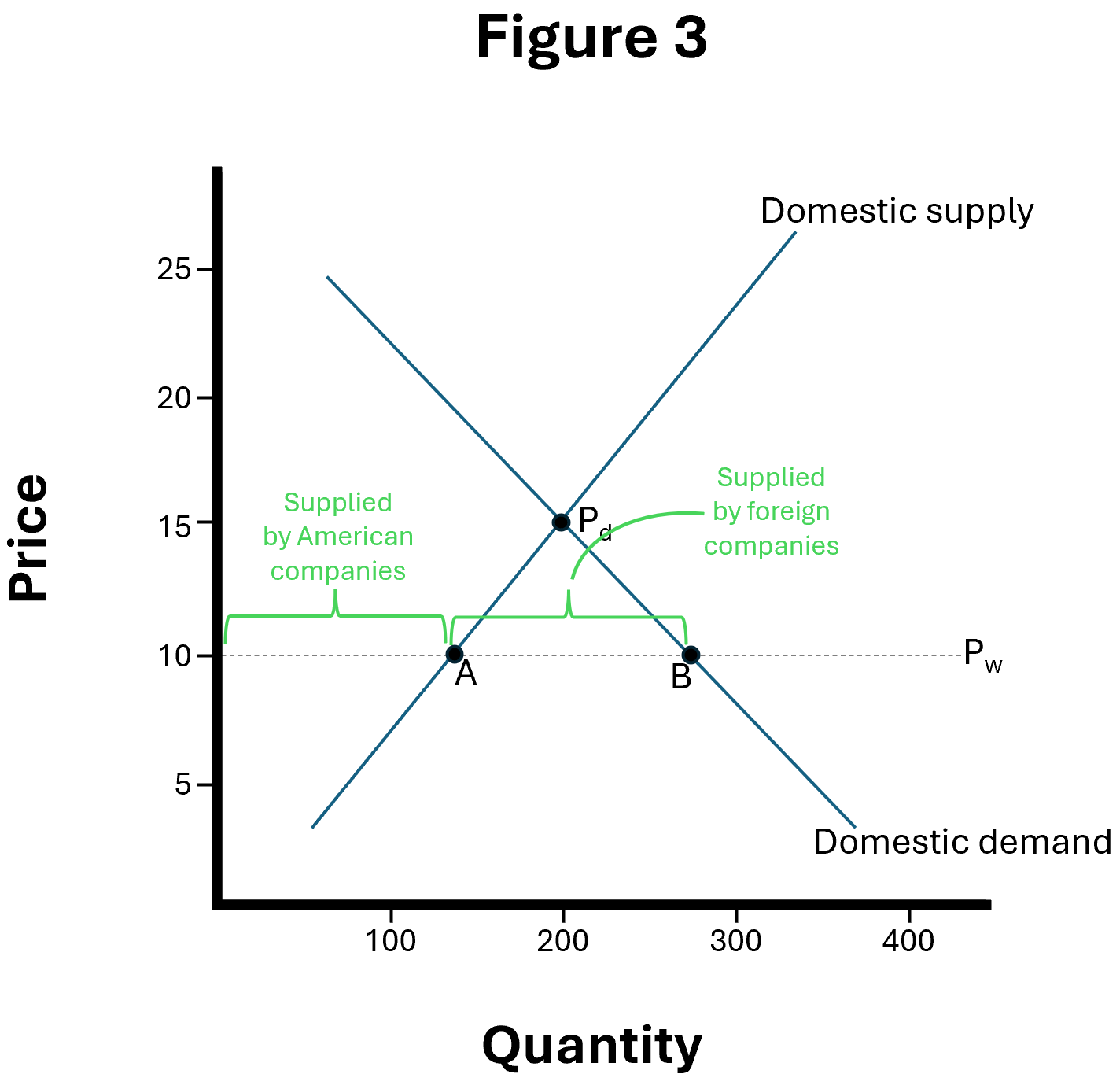
Now let’s add in worldwide free trade with no tariffs. If the world price (Pw) is only $10 (including transportation costs), this is how it would look:

That horizontal dashed line I added is the world price, which is $10. The price is so much lower than the domestic price that the quantity demanded is all the way up to about 275 units now (see point B on the figure), and that is supplied by a mix of domestic producers and foreign producers. Let’s look specifically at the X axis to see how much comes from each one.

We can see how much comes from domestic producers by looking at how much they’re willing to supply at that price of $10 (point A on the figure), which looks to be at around 125 units (rounding for simplicity). And the difference is made up by foreign producers (the distance from point A to point B), which is about 150 units (275 – 125).

Therefore, with free trade and no tariffs, American consumers would be saving $5 per unit of clothing they buy, and, of the total 275 units that they would be buying, 125 would be produced domestically and the other 150 would be imported, as demonstrated in Figure 3:

The important thing with this change is looking at (1) how much free trade benefited domestic consumers and (2) how much free trade hurt domestic producers.

We can calculate that by comparing the change in consumer surplus and producer surplus from Figure 1 to Figure 2.

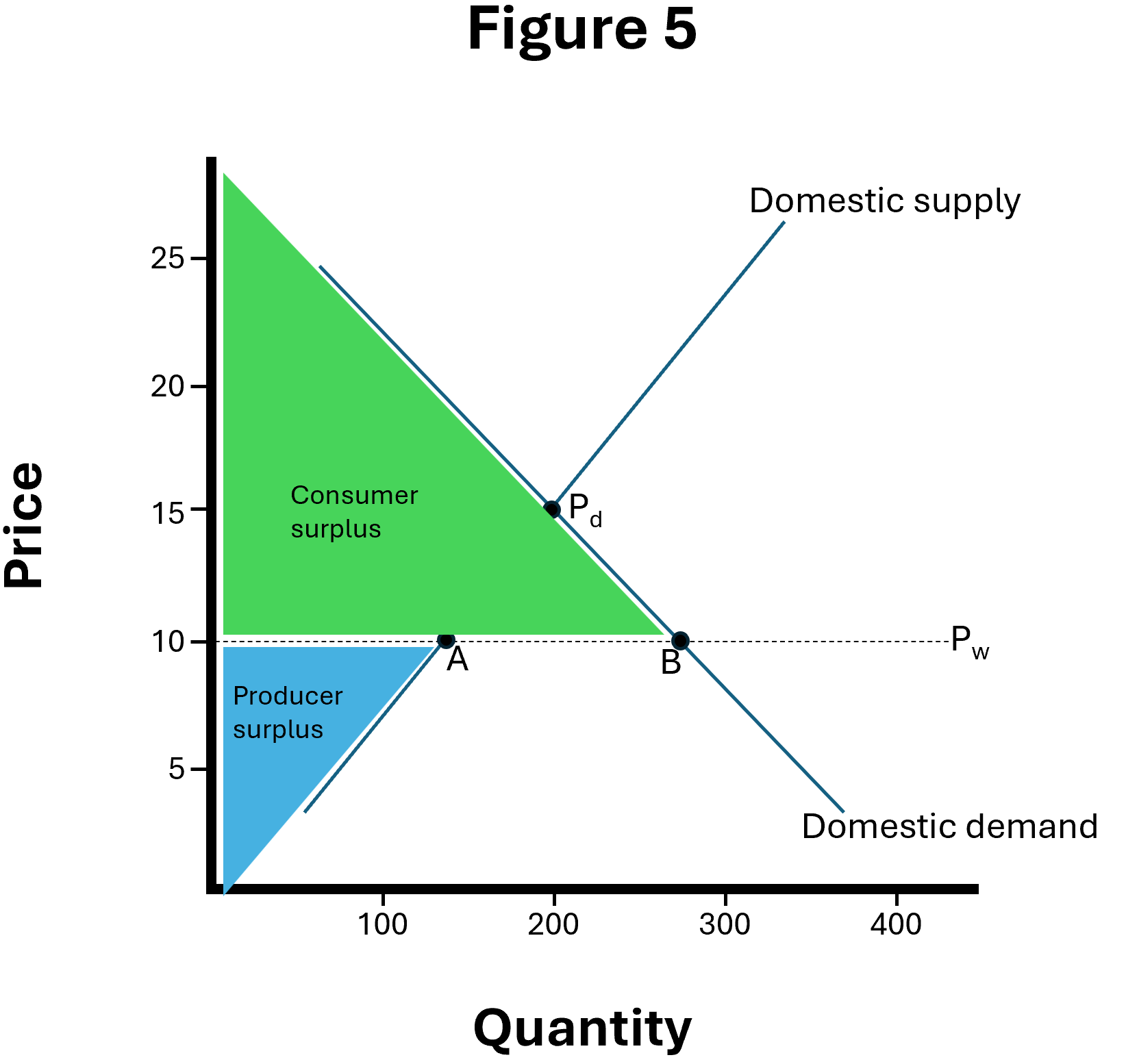
Consumer surplus looks at how much each person who bought the good was willing to pay compared to how much they actually had to pay, and it adds all of those individual surpluses together.

Producer surplus is similar–it looks at the lowest price each company was willing to sell its goods for compared to how much it actually sold its goods for, and it adds all of those surpluses together.

Surpluses are what we want–it means the consumer or producer gets to retain more wealth than they would have been able to otherwise, which gives them room to do other useful things with that wealth.

Here’s the consumer surplus and producer surplus for the zero-international-trade situation:

And here they are for the free trade situation:

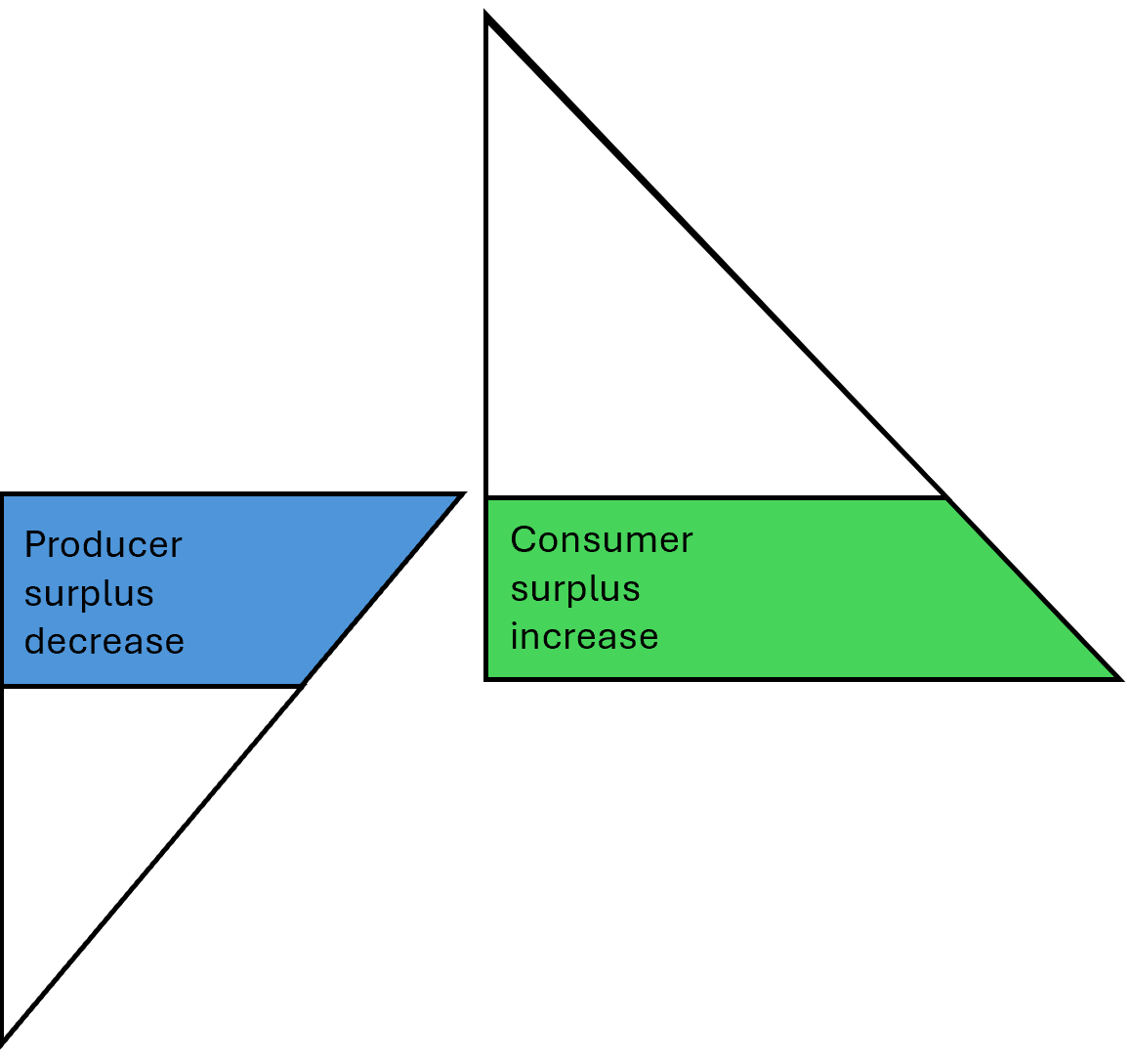
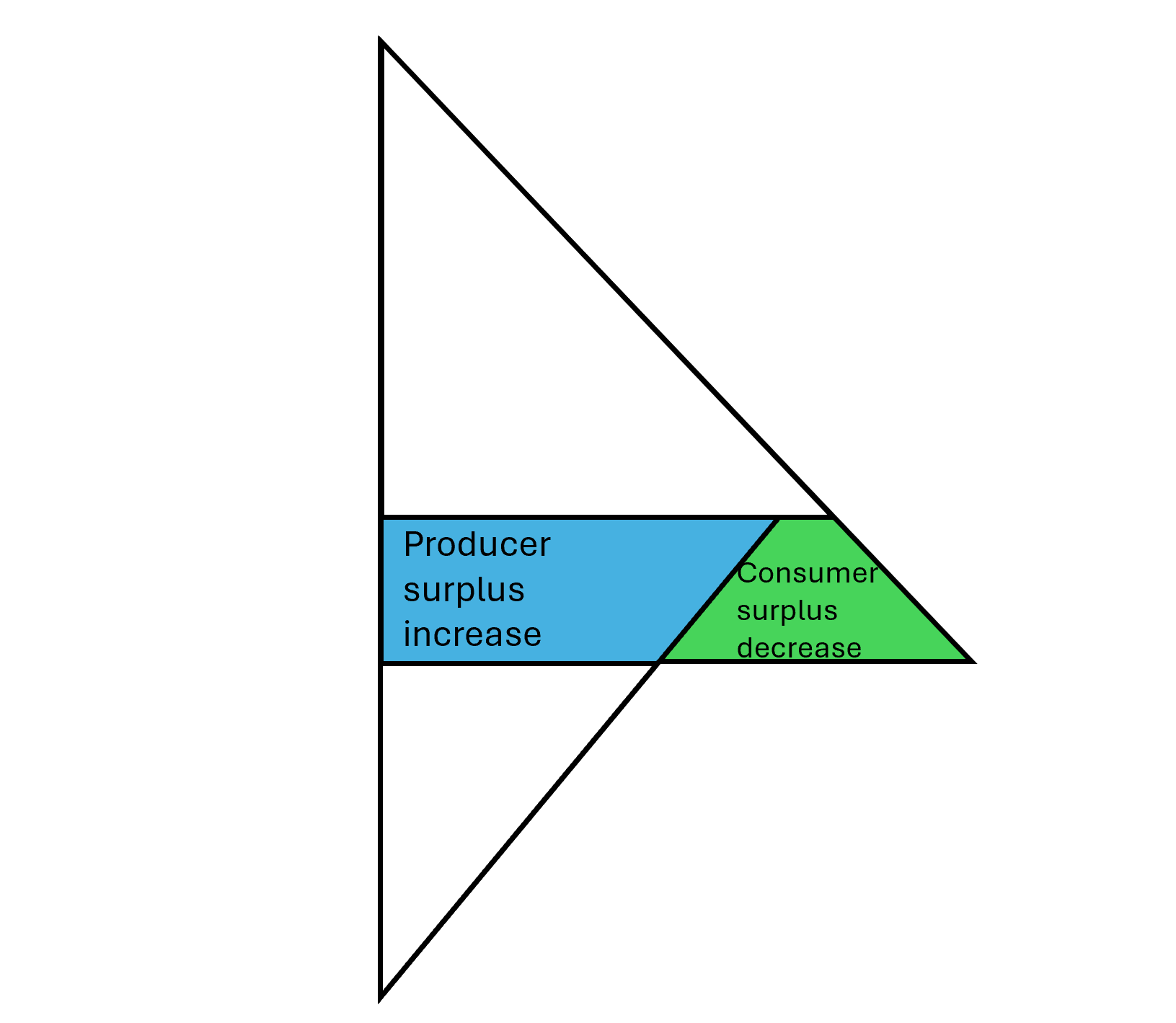
Did the consumer surplus grow more than the producer surplus shrank? If so, we have a net win for the overall wealth of our country!

Here’s a comparison (with some positional readjustment to more easily compare):

And here’s an overlay:

As you can see, there’s a good-sized net gain in wealth for the country because the consumer surplus increased a lot more than the producer surplus decreased.

In summary: With free trade, American consumers benefit a lot more than American producers lose.

This happens a lot with economics and public policy–a small benefit to everyone far outweighs the cost to a few.

This analysis applies to every industry in every country. Free trade is a huge source of additional wealth to any country.

Free trade is beneficial for other economic reasons, too. It improves international relations, which decreases the likelihood of war (which is nice because war is one of the biggest wealth-sinks). And it shifts the limited supply of labour in each country from relatively lower-value industries (i.e., the industries that are shrinking due to losing market share to international competitors) to relatively higher-value industries in that country, which allows wealth to grow faster over time due to a higher average productivity of workers worldwide.

But what if we analyze this free trade policy from a narrower perspective? Let’s only consider its impact on U.S. jobs. Its immediate effect was that domestic clothing producers used to be producing 200 units annually, and now they’re only producing 125 units annually. Free trade almost cut the American clothing industry in half from a production standpoint, and I suspect that would result in approximately half of the American clothing jobs going away to other countries.

As you can see, free trade can look really bad from a narrower perspective. But, remember–that’s a limited perspective. When you also take into account the benefit to domestic consumers, the net effect is a great increase in our country’s wealth.

This brings up a hypothetical worst-case scenario: What if all of a country’s industries are higher priced than its international competitors? Would that mean prices for everything would be really low but nobody would have a job?

No.

Reason #1: There are many goods (and even more services) that can’t be imported (for example, hair cutting, chefs in restaurants, electricians, etc.), so many jobs would still exist.

Reason #2: Remember the caveat I gave earlier about how the value of something is really what people use when they’re shopping for stuff. Even if the average price of goods coming out of a country are higher than the world price in every case, there would still be people around the world who think that certain products from that country are the highest value, so there would still be demand for that country to export all sorts of goods.

Reason #3: This is the most important one. You have to remember that the world is not a static snapshot. It’s a dynamic world where things change over time. And so how that country responds to this severe trade deficit (they’re importing a lot more than they’re exporting) depends on its regulatory environment and economic policies. There may be a time of high unemployment, but more realistically as certain industries shrink due to free trade, other industries would be growing, especially in a minimally regulated and capitalistic society. New companies and entire new industries would be created by entrepreneurs, and the country as a whole will shift its labour force into those industries that that country is particularly good at, and wealth will continue to grow for that country. However, if the country is a highly regulated and central-planning-based economy, the likely result of free trade-induced job losses is that the government would enact trade barriers (such as tariffs), thus slightly decreasing its unemployment rate in the short term and extending indefinitely its relative poverty in the long term. That’s what can lead to a situation where the government has to turn to increasingly totalitarian policies to prevent people from emigrating or, worse (from the totalitarian government’s standpoint), staying and blaming the government for their poverty.

To summarize my answer to this worst-case scenario: Free trade is still the best policy in the long run.

To some extent, that worst-case free trade scenario applies to the U.S., which has some of the most expensive labour and, thus, consistently higher prices than the world price. Fortunately, we are a pretty capitalistic society, and with the help of the Department of Government Efficiency (DOGE), we’re (1) simplifying our regulatory environment and (2) releasing workers from a relatively unproductive sector (government jobs) so that they can instead find employment in relatively more-productive sectors (private jobs). Both of those changes bode well for the prosperity of America and for the unemployment rate as well.

And now I have one more little point to clarify about the above figures: How would free trade affect a country whose clothing price is lower than the world price?

The answer: Nothing much would change. Domestic producers would continue supplying the majority of domestic demand, so the free trade policy wouldn’t induce any significant job losses in that industry.

You could liken this to the car industry in Japan. The Japanese make some of the highest-value cars in the world, so it makes sense that the majority of cars sold in Japan are of Japanese make. In fact, out of the top ten car manufacturers (by market share) in Japan, all of them are Japanese. Thus, Japan’s zero-tariff policy for cars really has a minimal impact on the Japanese car market.

Now, let’s finally look at how the addition of a tariff would impact a country!

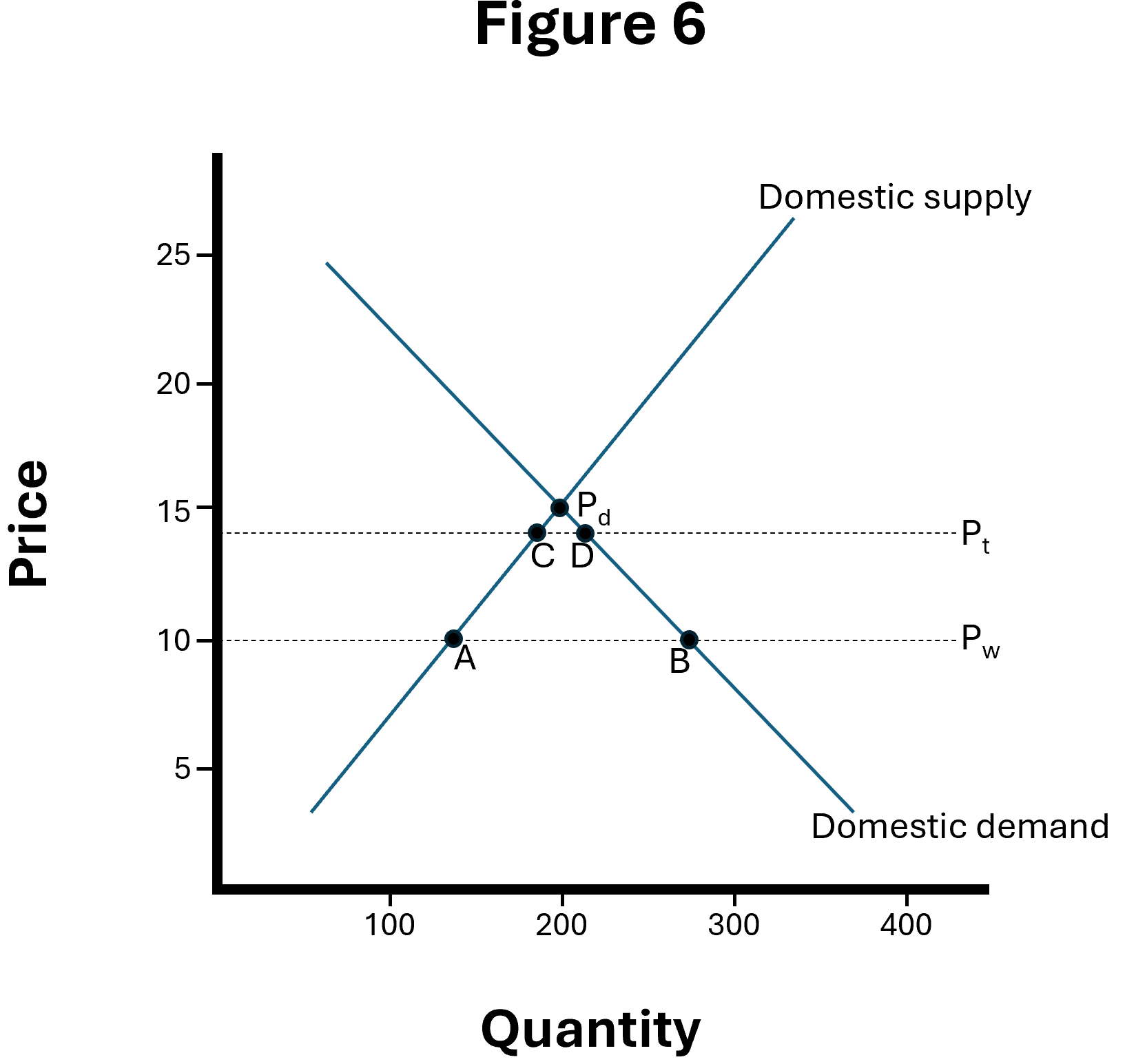
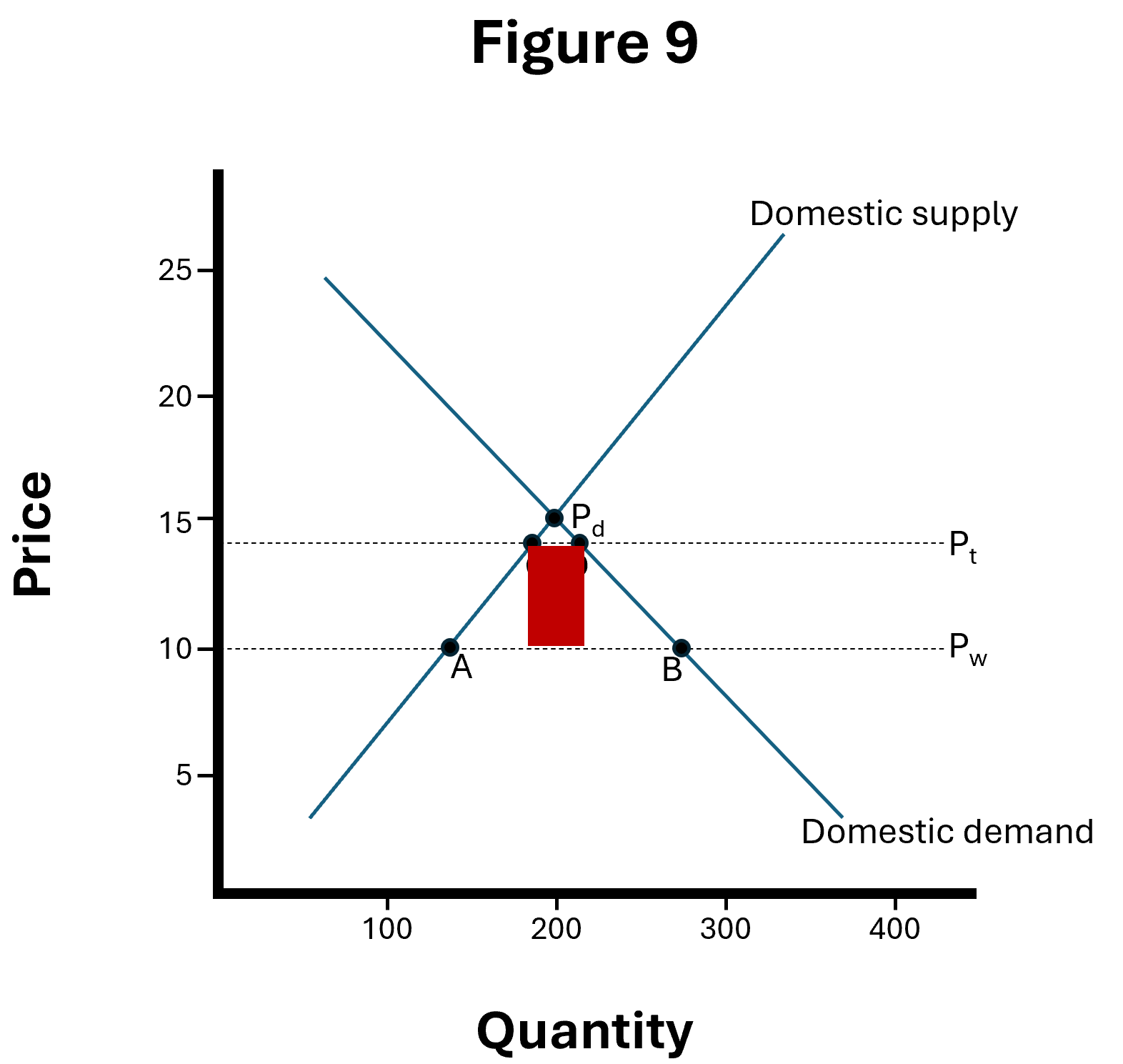
Here is the effect of adding a 40% tariff to our example of clothing:

As you can see, the world price is still $10, and the world-price-plus-tariff (Pt) is $14. At that new $14 price, domestic demand has dropped from 275 units annually to about 225 units annually. And of those 225 units, about 175 of them are provided by domestic producers, and the other 50 units are provided by foreign producers, as shown in Figure 7:

Things get interesting when we analyze how the tariff impacts consumer surplus and producer surplus:

And comparing that to the surpluses without the tariff:

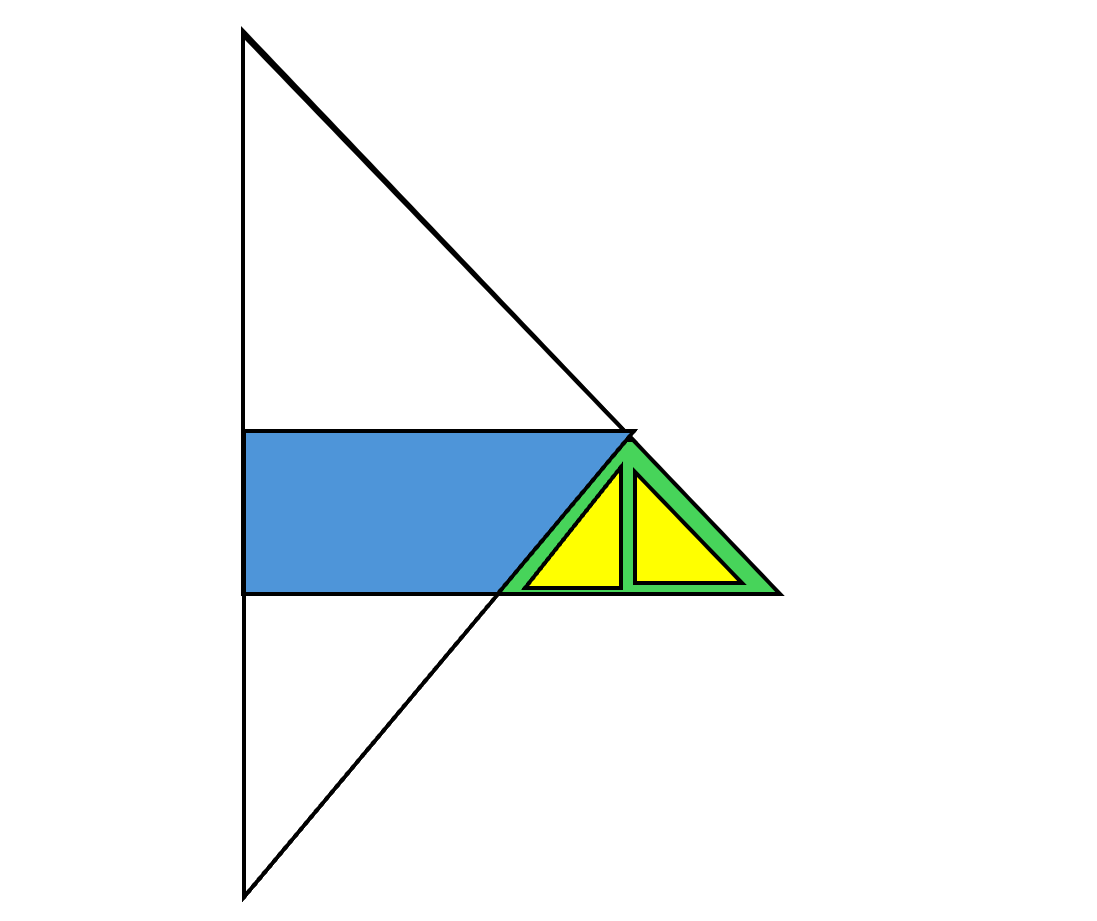
And doing the same overlay as last time:

As predicted, there is an excess decrease in consumer surplus. In other words, the tariff hurt consumers more than it helped producers, so it was a net harm to the country’s wealth.

But wait! We have to consider the money the government earned in this because, remember, the government is earning $4 for every unit of clothing imported. Here’s how the government’s surplus (tariff revenue) would look if we highlight the area on the graph:

Just to make sure the interpretation of the size of that box is clear, remember that the government only earns tariff revenue on the 50 units imported, and it only earns the extra $4 that it’s charging on those units.

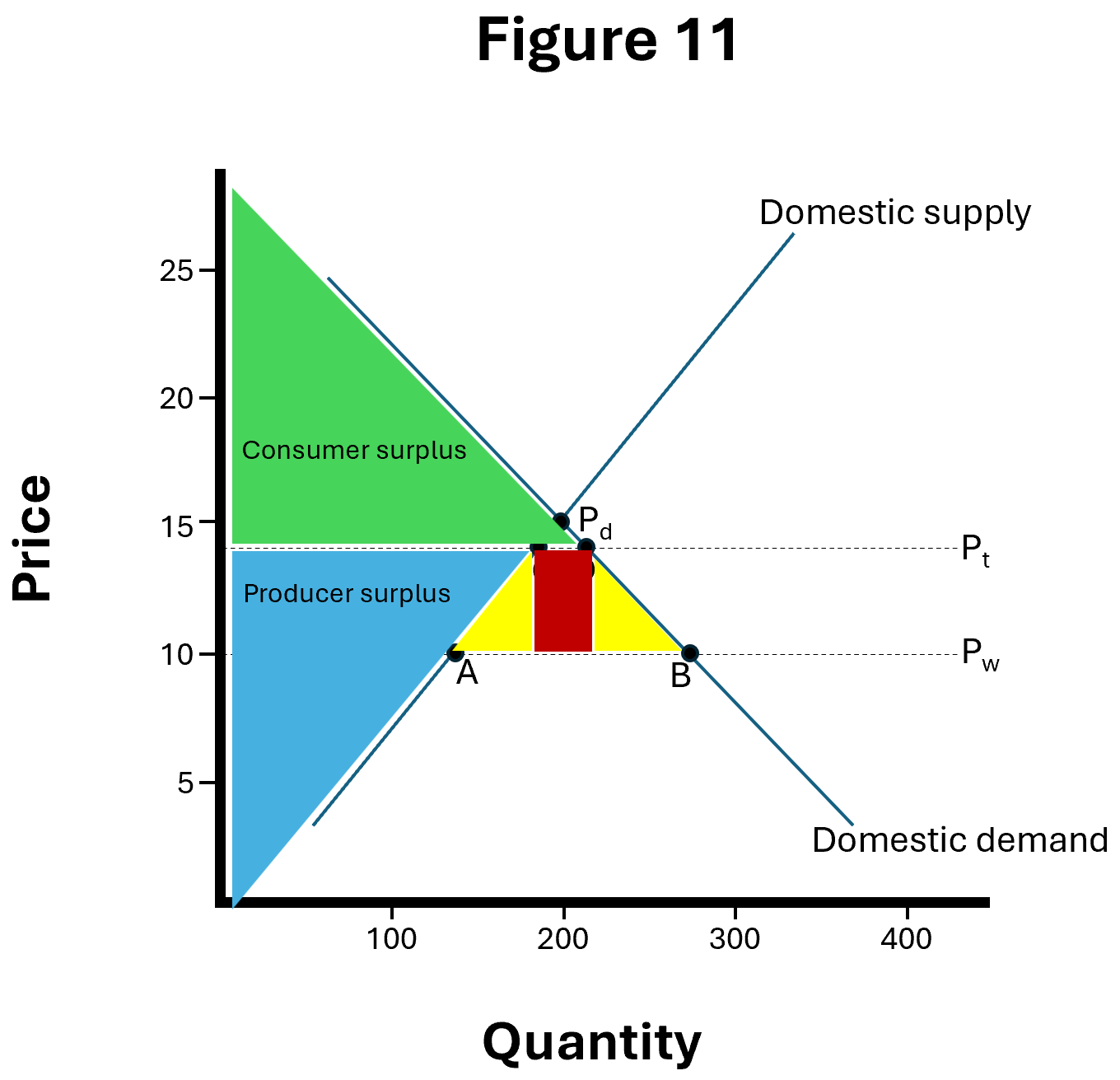
If I add the consumer surplus and the producer surplus back into the graph, here’s how it looks:

Do you see those two conspicuous empty triangles (to the left and right of the government’s tariff revenue) that used to be consumer surplus (see Figure 5) before the tariff was added? Here, let me highlight them:

Those yellow highlighted areas used to be consumer surplus, but now they’re not anybody’s surplus. It’s wealth that has been lost due to the tariff. We call it deadweight loss.

Before dismissing this as trivial, compare those to the benefit we gained from implementing free trade in the first place:

The tariff-imposed deadweight loss almost negates all of the benefits we originally gained from free trade.

[Feedback from one of you guys: In this example, the tariff-imposed deadweight loss was almost as large as the benefits originally gained from free trade, but the amount of deadweight loss a tariff causes can vary quite a bit depending on the slope and shape of the supply line and demand line (i.e., their elasticity functions), the size of the tariff, and also the difference between the world price and the domestic price. So, that deadweight loss could end up being only a small fraction of the size of the consumer surplus bestowed by free trade, or it could even be larger.]

I like efficiency because it brings greater wealth and improved quality of life. And I dislike deadweight losses because they make wealth evaporate and worsen quality of life. So this makes me pretty unhappy about tariffs.

But wait! Isn’t all of this negated by a variable I’m not taking into account? What about the claim that other countries are paying for that tariff?

Let’s look at exactly how the money flows. First, the U.S. government imposes a 40% tariff on imported clothing. The foreign producers have to pay this 40% of the price of their goods directly to the U.S. government when their goods hit our border. But foreign companies can’t simply absorb that 40% cost increase. Heck, most companies’ profit margins are way less than 10%. So they will have to raise their prices in response to that 40% tariff. If they raise their prices by approximately 40%, then what has happened is the foreign producer has paid the tariff directly to the U.S. government, but they are getting the extra money to pay for that tariff by charging higher prices. And who pays the higher prices? We do. American consumers do. We’re the ones buying the goods for $14 now instead of $10.

So, the definition of a tariff is that it’s a tax on imports, but the important thing to understand is that tariffs are not taxes on foreign companies; they’re indirect taxes on domestic consumers.

There is an argument that, in order to remain competitive after a tariff is implemented, foreign companies may be willing to take slightly less profit, so they would absorb a portion of the cost of the tariff by not raising their price by the full amount of the tariff. But this would only cover a small portion of the tariff because, again, companies are very limited on how much they can absorb cost increases.

This means that the claim that, “through tariffs, other countries will fund our government” is demonstrably false. The money the U.S. government makes from imposing tariffs will come from American consumers indirectly. Just like inflation, tariffs imposed by the U.S. government are an indirect (and, therefore, usually hidden) tax on Americans.

[Update 2/12/25: There are scenarios where foreign companies and governments can actually make that statement true. For example, I already mentioned that a company could choose to take a hit on their profit and not raise their U.S. price by the full amount of the tariff. Their government could facilitate that by subsidizing the company, thus replacing the lost profit and allowing the company to even continue selling their goods at the same price! In that case, you do in fact have the foreign government paying the cost of the tariff. I haven’t looked into data on this topic, but I suspect this only happens in a minority of cases. And, if it is happening, then it signals to the U.S. government that it can increase the tariff even further to take advantage of (maximize) this wealth transfer from the foreign government to American consumers.]

[Another update 2/24/25: Another factor I didn’t originally account for above is when the U.S. imposes a tariff on a country that is highly dependent on exports, especially to the U.S., how that can affect exchange rates. If a country is about to lose a large chunk of its economy, investment in that country will drop, as will the demand for that country’s currency. The result will be a devaluation of that country’s currency. So, for example, if a company raises the prices on the goods they’re exporting to the U.S. by the full amount of the tariff BUT the new exchange rate with that company’s country’s currency has changed to make products from that country cheaper, then the price increase is offset a little bit through us hurting their economy. I think this effect is unlikely to offset much of the cost of the tariff to American consumers, especially in the long run, but it’s worth mentioning because I hear the argument being made.]

Therefore, President Trump’s “External Revenue Service” turns out to be a misnomer and would be better named the “Deadweight Loss-Inducing Indirect Internal Revenue Service.” Or, the DLII-IRS for short. Nice, snappy.

Importantly, this doesn’t mean that tariffs are always the wrong choice, as I’ll get to. But if you’re going to support them on the basis of the claim that they will facilitate foreigners funding our government, your support is misplaced.

Ok, let’s review where we’re at.

We found that free trade enriches any nation that engages in it, in spite of the risk of a short-term decrease in jobs (or long-term decrease depending on the country’s economic and regulatory situation). And we found that tariffs obliterate most of those benefits gained by free trade (depending on how big the tariffs are).

What we haven’t done yet is summarize the impact on each party after tariffs are implemented, so let’s do that now:

American consumers: Large costs imposed on them by the tariffs because they are the ones losing surplus (in the form of benefits to American producers plus benefits to government plus deadweight losses).

American producers: Tariffs benefit them–they will sell more goods and earn more profits and create more jobs. But, again, these benefits are outweighed by the costs to American consumers.

One little extra tidbit about tariffs’ effect on American producers: I’ve only talked about the benefit tariffs give directly to the American producers whose competition has just become more expensive as a result of the tariff, but I haven’t mentioned the indirect (and often negative) effects a tariff can sometimes have on other producers. For example, if American companies are highly dependent on a foreign supplier because that supplier makes an input to the exact specifications the American companies need, and then that supplier gets hit with a tariff, it has raised the supplier costs for all those American companies, which can obviously have all sorts of negative effects. For simplicity, I will ignore this indirect effect of tariffs for the rest of the post, but I figured it was at least worth mentioning.

American government: Tariffs benefit them because they (1) earn more money and (2) also wins PR points if, in response to the tariff revenue, they decrease direct forms of taxation (such as income tax). This PR win hinges on the American people not realizing that they are still funding the government, only now it’s in the form of higher prices rather than direct taxes. And, unfortunately, because of the deadweight losses imposed by the tariffs, for the government to continue earning the same amount of revenue, the decrease in direct taxes can never be as large as the increase in prices.

Foreign companies: They will sell fewer units and, thus, probably lay off some workers. This means that there will be a net shift of jobs from their country to the U.S. as a result of the tariff. They may also end up making less profit per unit sold if they choose to lower their prices to remain competitive in the face of the tariff headwind.

[Update 3/25/25: Another argument I’ve been hearing lately about tariffs is that they will induce foreign companies to invest in new production capacity in the U.S. to avoid having to pay the tariffs. This is just another way of saying what I’ve already said above: After a tariff is instituted, domestic supply increases. Whether that increase in domestic supply comes from domestic companies increasing capacity or foreign companies increasing capacity in the U.S., the result is the same–we have more jobs in the U.S. and more of our products are being supplied by stuff that was produced domestically. The one benefit of foreign companies doing this, though, is that it is increasing foreign investment into the U.S. But foreign investment also means the profit they earn gets sent back to that foreign country, so, in the long run, it’s siphoning wealth from the U.S. When you have this nuance in mind, the individuals arguing that “foreign companies will start making huge investments into the United States” actually start to sound pretty ignorant. This is yet another reminder that a rich and/or intelligent thought leader who speaks with confidence and is trusted by millions can be totally wrong, and I believe that happens even more often when that thought leader’s tribalism leads them to not be critical enough of claims made by their tribe.]

Do you remember way at the top of this article, in the title, where I said that tariffs can be good?

Yes, tariffs can make sense if they are used for reasons other than to “make other countries fund our government.” Let’s review a few cases where they can make sense.

Tariffs Can Be Good Reason #1: Tariffs can make sense when they are used as a threat to punish behaviour we don’t like. As should be clear by now, the main punishment a tariff inflicts is stealing their jobs (i.e., shifting some jobs from their country to ours).

What kind of undesirable behaviours would justify threatening a tariff? One example would be when neighbour countries are not doing enough to help prevent drugs from being smuggled across our borders because of lax border control. Another would be when countries allow infringements on American intellectual property.

The hope is that the tariffs will not be imposed–only threatened–because, ultimately, as I have shown, the tariffs will also financially harm Americans. But, sometimes the benefit we could gain from a tariff (in the form of motivating policy changes in the other country) justifies the cost to ourselves, assuming the tariff works sooner or later to bring about the desired changes.

Before moving on to reason #2, let’s explore just a bit further how much our tariffs could hurt other countries, which would impact how powerful our threat of tariffs would be.

Let’s say that 50% of a country’s economy is built on exports by its clothing industry. If the U.S. only represents 10% of that country’s clothing sales, and we impose a large enough tariff on their clothing exports to us that it shifts half of those sales over to American producers, we have just cost that country approximately 5% of its clothing jobs, which would be 2.5% of its total jobs in the economy. That’ll hurt, but it’s something they could weather.

But what if America, as a huge and wealthy country, represents 60% of that country’s clothing sales? Then, if we impose a tariff that shifts half of those sales over to American producers, it will cost that country 30% of its clothing jobs, which would be 15% of its total jobs in the economy. That would be devastating.

So, a tariff will certainly hurt America’s wealth, but it can hurt other countries much more, especially when (1) the country’s economy relies heavily on exports and (2) the U.S. is a major purchaser of those exports.

Tariffs Can Be Good Reason #2: Tariffs can also make sense if they are used to diversify critical supply chains.

For example, do we really want to be dependent on China for all of our microchips and Russia for a large percentage of our fossil fuels? Imposing tariffs on such national security-critical products can help boost domestic production of those products, which makes us less dependent on other countries that could potentially cut off our supply of critical products.

Having said that, a more efficient way to achieve this might be through direct industry-wide subsidies, which would avoid the deadweight losses that tariffs incur. But, when a government chooses subsidies rather than tariffs, it doesn’t get additional revenue and the potential PR wins that tariffs offer; instead, it would just be spending more money, and it might have to raise taxes to do so.

Therefore, even though subsidies probably make more sense than tariffs to help us diversify critical supply lines, governments are much less motivated to use subsidies to do so.

[Addendum as a result of a comment from one of you guys 2/15/25: Subsidies have their own set of problems that I didn’t adequately acknowledge. One is that they tend to stick, and then the training wheels never come off and the domestic industry becomes inefficient and uncompetitive compared to the global marketplace. Another is that oversubsidization for a long period of time can force many of the global competitors out of business, creating undue consolidation and even a global dependency, which can be especially bad if the subsidization goes away suddenly and other countries have to scramble to develop domestic production capacity. None of this should be news–all government interventions in markets have the capacity to do more harm than good. And that applies to subsidies, too. This is why I tend to be a minimalist when it comes to government interventions in markets, but appropriately regulating markets to improve the incentives in them, if done properly and not under the influence of special interests, can be a very important way that governments help markets.]

Tariffs Can Be Good Reason #3: Sometimes temporary tariffs can be helpful to foster fledgling domestic industries. This is similar to reason #2, only the purpose is different.

In this case, the government is making a bet on a fledgling domestic industry. It thinks that that industry, if given a little boost in the form of protection from competition early on, will be able to grow and become efficient and also competitive in the world market, all of which would bring great wealth to the country.

But, again, the tariff should only be temporary. Once the fledgling industry has gotten off the ground, the tariff should go away.

So the hope with this type of tariff is that the cost imposed on the country’s wealth during the time the tariff was active will be more than made up for by the wealth brought in by that new wealth-generating industry it helped foster.

Tariffs Can Be Good Reason #4: Let’s talk about retaliatory tariffs.

Should the U.S. impose/increase tariffs on countries that impose them on us?

It depends.

To explain the answer, let me introduce a new term. I’ll call it “tariff damage potential.” This will specifically refer to how much damage a tariff can impose on the other country’s economy. We know that a tariff has a guaranteed and predictable harm on ourselves, but the tariff damage potential only refers to its effect on the other country. And while the damage a tariff imposes on your own country’s wealth is fairly predictable, the damage it imposes on the other country can vary widely and is mostly dependent on (1) how much that economy relies on exports and (2) how big of a trade partner the U.S. is to that country.

Therefore, if the U.S. buys a large percentage of a country’s exports, and their economy is heavily dependent on exports, our tariffs on them have a huge tariff damage potential, which I already demonstrated above in the “Tariffs Can Be Good Reason #1” section.

And this idea works both ways. If the U.S. economy were highly dependent on exports, and if a certain country is one of our huge buyers, then that country’s tariffs against the U.S. also have a huge tariff damage potential.

So, deciding on the best course of action when another country imposes tariffs on us comes down to comparing our tariff damage potential to theirs. If our tariff damage potential on them is greater than theirs is on us, then it makes sense to impose retaliatory tariffs.

Let’s look at an example to illustrate this.

What if the Motherland (Canada) drinks too much beer and, in its drunken stupor, decides to impose a 25% tariff on all products from the States? And, in response, the U.S. imposes a retaliatory tariff of 25%. Canada has started a “trade war.”

Since Canada’s economy is more dependent on exports than the U.S.’s, and since Canada exports 77% of their total goods to the U.S. and the U.S. exports only 18% of its goods to Canada, you can see how this will go.

I’m not sure concrete numbers to calculate what the net shift of jobs would be from Canada to the U.S. would make my point any clearer, especially because of the extensive assumptions I would have to make (since I’m not equipped to do econometric analyses), but it’s safe to say that Canada would be hurt by the U.S. tariffs a lot more than the U.S. would be hurt by Canada’s, meaning there would be a sizable net shift of jobs from Canada to the U.S. So this would be a situation where retaliatory tariffs would make sense.

The principle here is that we should always impose retaliatory tariffs if our tariff damage potential is greater than theirs, with the specific goal of discouraging other countries from imposing tariffs on us. And since the U.S. (1) is not as highly dependent on exports as most wealthy countries are and (2) has the largest economy in the world, I suspect retaliatory tariffs will make sense with every major trading partner we have.

But, if there’s a rare case where our tariff damage potential is smaller than theirs, then the right response is not to impose retaliatory tariffs. Instead, we just have to keep relying on capitalism and a minimal and simple regulatory environment to continue growing our wealth. And, if we end up growing faster than the tariff-imposing country and, as a result, our tariff damage potential grows larger than theirs, then we impose retaliatory tariffs.

But, importantly, what would be best for everyone would be free trade! So retaliatory tariffs should always be conditional. In other words, they should always come with a promise: If you eliminate your tariffs on us, we will eliminate ours on you.

From a game theory standpoint, I think the best policy for the U.S. is to commit to imposing conditional retaliatory tariffs on every trade partner whose tariff damage potential is smaller than ours, and we should make that policy very well known. That way, any trade partner will know that, from this point forward, imposing tariffs on us (or continuing pre-existing tariffs) will hurt them a lot more than it will hurt us. And that will force our trading partners to weigh that guaranteed cost carefully before choosing to impose tariffs on us. The end result would likely be fewer tariffs between us and our trading partners, which is really the goal here.

With all this information in mind, it’s pretty strange that Prime Minister Trudeau recently threatened to impose a retaliatory tariff on the U.S., justifying it by saying that he’s sticking up for Canada. Such a policy is not likely to hurt the U.S. enough to make President Trump back off from his tariff threat, so it would probably only hurt Canadians further.

Before concluding, there’s one more argument about tariffs that I want to respond to.

I see many people arguing that tariffs are good based on historical trends. For example, sometimes they reference the U.S. in the late 1800s and early 1900s, when the government relied heavily on tariffs for revenue and there was strong economic growth. They see that there was huge GDP growth during that time, and they assume it was because of the tariffs. Other people will argue that such-and-such good had a tariff imposed in such-and-such year, and it didn’t make the price go up.

There are situations that I’ve explained above that could account for a tariff not making a price rise, depending on what the world price of the good is compared to the domestic price. But, that aside, the important thing to recognize here is that each of those arguments are based on a fallacy: seeing a correlation and assuming causation. For example, when a tariff is implemented and the price doesn’t rise, rather than assuming that means tariffs don’t induce price increases, try looking into other factors that could have occurred at the same time to offset the price-increasing effect of the tariff. And here’s another example: If America’s GDP grew quickly during a time of high tariffs, rather than assuming the GDP grew quickly because of the tariffs, maybe look at other factors from that time period to figure out why GDP grew quickly during that time, which may lead you to wonder how quickly GDP could have grown had tariffs not been inducing so many deadweight losses during that time period.

The economic principles that I’ve laid out in this post are well established, and if someone wants to make a contrary argument based on historical anecdotes or assumed causation, they have the burden of proof to explain and demonstrate precisely what causal mechanism their argument is based upon. And, if they can successfully do that, then we’ve learned something new and can now more accurately understand and predict the world! And that allows us to make better policies moving forward, which will improve lives. Winning, all around.

In conclusion, how would I sum up this lengthy post?

Maybe I would just say this:

Tariffs interfere with free trade, so they decrease the overall wealth of any country that imposes them. But there may be situations where there is a large enough potential benefit to justify them, including the four reasons I listed above (and I acknowledge that there may be others I haven’t thought of). But we need to be really deliberate about identifying those potential benefits and weighing them against the guaranteed costs before we ever impose a tariff.

What’s best for American consumers? No tariffs.

What’s best for American producers? They may want tariffs to help boost their sales, but I’d prefer we take off the training wheels and let them compete in the global market, which will ultimately be better for everyone.

And now, as a reward for those who got all the way to the end of this post, I will share my two favourite comments I received on X in response to sharing some of these details about tariffs:

People on the internet are just so entertaining! I try not to troll, but it’s very tempting sometimes.

Pay for Performance and Shared Savings are Good, But They’re Not the Solution

I published this article on KevinMD on 1/9/25, but I want a record of it here as well since this is my central repository for all of my healthcare writing.

So here’s the link:

https://kevinmd.com/2025/01/pay-for-performance-and-shared-savings-are-good-but-theyre-not-the-solution.html

For regular followers of this blog, the principles discussed in that article are not new. But the framing for how I’m putting some of them together is new, so I hope it helps give people a more rounded understanding of the futility of many of CMS’s alternative payment model programs. Their outcomes are just what I predicted in my 2016 article.

It’s amazing how predictive a theory can be when it’s based on an accurate understanding of the principles at play.

Why the United States’ healthcare spending became a world outlier

After thinking and writing about healthcare for so long, I don’t often learn new things that turn out to be a big part of the puzzle. But this is one of them. I hope you can follow my thought flow as I explain.

First, I was thinking about something I’ve directly experienced a number of times. In talking to the upper-level managers of healthcare providers about their pricing, increasingly often they’re creating a list of cash-pay prices, which they use to determine how much to charge patients who either don’t have insurance or who, for whatever other reason, want to pay out of pocket for a service. But they’re almost never willing to have those price lists shared publicly.

Why?

Quick sidenote: The fact that providers are doing this so much more, and as pushed by some of the government transparency initiatives as well, is huge! Before, providers would use the chargemaster price when a patient wanted to self-pay. And since chargemaster prices aren’t even close to grounded in reality (for reasons that I’ve discussed before and won’t rehash here), it was a major ripoff if you didn’t purchase through insurance.

Anyway, the answer is that they worry that it will get them in trouble with insurers, presumably because if a cash price turns out to be less than the negotiated price with even one insurer, if the insurer finds out about it, the insurer will refuse to pay their previous (higher) price, so the provider will lose bigtime during the next round of contractual price updates.

Essentially, this means that providers’ attempts to create self-pay price lists (in an attempt not to screw over uninsured patients) could cost them a lot of revenue from insurers. So they keep them mostly secret.

And I suspect this is such an issue because of gag clauses in provider-insurer contracts. Gag clauses prevent either party from divulging the agreed-upon prices, which probably also indirectly prevent providers from being willing to share any prices publicly.

So that’s where my mind was at, thinking about this whole issue of price opacity and the fact that prices between private parties in healthcare are set through bargaining power-based negotiations between insurers and providers. And it led me to start thinking harder about the upsides and downsides of negotiated pricing versus standard pricing. Here is the definition I’m using for each of those terms:

Negotiated pricing is setting prices based on the relative bargaining power between the buyer and the seller.

Standard pricing is a seller setting their price wherever they want, and the buyer has a choice to buy from that seller or not.

The big realization I’m making–which also has big implications on why our healthcare system performs the way it does (as I’ll describe at the end of this post)–is that negotiated pricing kills a ton of value-sensitive decisions. Even worse, opaque negotiated pricing kills even more value-sensitive decisions.

The effect of something preventing a large chunk of value-sensitive decisions is that it weakens the link in that market between (1) delivering high-value products and services and (2) earning more profit. So the value delivered by that market no longer rises over time like it otherwise would because competitors are too busy competing over the new things (rather than value) that determine how much profit they will win. New things like market share, which empowers them to negotiate up prices. And we wonder why the healthcare market has rolled up (i.e., become consolidated into a small number of very large companies) like it has. How else can you earn more profits when prices are set mostly based on bargaining power-based negotiations?

Another side note: For those interested in business strategy, I’ve never heard anyone talk about this as a factor that pushes an industry to consolidate, but it’s probably a major factor in many industry roll-ups. Another factor, more well know, is if there are significant economies of scale to be had, that will also push an industry to consolidate.

So how does negotiated pricing kill value-sensitive decisions?

I’ve tried several times to explain this part, and I’m still failing to some degree, which means I haven’t pieced everything together well enough yet. So here’s my best shot, which might still be confusing.

When all the prices between insurers and providers are set through negotiated pricing, they aren’t as closely connected to what is truly valued in the market. This relates to the importance of prices in a free market and how they are the most important thing that conveys the value of something. Hayek wrote about this. So the prices don’t connect to what the true market price would be, which makes for an inefficient market when people are trying to determine and choose the highest-value options. There would still be a link between value and profit, it would just be a lot weaker. But, make it even worse by adding in the propensity for negotiated prices to be opaque, and now you’ve taken away the ability for individuals to know relative prices at all (assuming the prices are opaque to the decision maker), so you’ve completely killed value-sensitive decisions.

Related:

What I’m saying is that negotiated prices have caused two problems in our healthcare system: (1) The person making the decision on where they will receive care (i.e., the patient) no longer has any idea of the price of things, and they usually don’t care anyway because they usually pay the same amount regardless (through a flat co-pay, for example). (2) Sellers are unwilling to make any other prices public–including self-pay prices–for fear of it interfering with their gag clause or costing them money in the future when others demand that same price if it ends up being lower than a negotiated price.

The overall effect of shifting our healthcare system from its original standard pricing to negotiated pricing is that it eliminated a ton of value-sensitive decisions. And, once you hit a critical mass of non-value-sensitive decisions, the sometimes harsh incentive of the market for competitors to improve value (or else go out of business) gets significantly weaker.

So how did we come to have negotiated pricing in our healthcare system?

We had some amount of it even from the 1930s with Blue Cross and Blue Shield plans, although the details of these arrangements suggest that they didn’t get translated into taking away the ability of patients to identify the price of their different options and choose accordingly.

But what really caused the shift was the Health Maintenance Organization Act of 1973.

Here’s some context for that Act: Healthcare innovation was increasing how much providers could do for patients, and some of those new things were very expensive. Consequently, the price of insurance was rising fast enough that people were trying to come up with new ways to lower healthcare spending. The big idea that took hold was to try to reduce the number of unnecessary services provided by providers by having insurers review proposed services and approve or deny them. It makes sense–fee-for-service providers get paid more when they do more, so they have an incentive to do more things for patients, including things that could be of dubious value. The solution worked, to an extent–the insurance companies were able to prevent a lot of questionable-value services from being performed.

This caused problems, too. The usual big complaints about HMOs is that (1) they would inappropriately deny things and delay services and (2) they caused a ton more administrative costs. All this is true. But possibly the biggest drawback is that it started us down this road of shifting to negotiated pricing.

When insurance companies starting forming HMO plans, they needed to have a limited provider network so that they could restrict their beneficiaries from receiving care outside of an HMO contract. Limited provider networks based on contracts between the insurer and the providers opened up another possibility for insurers: If a big insurer has a lot of market power by virtue of insuring a large percentage of the people in the region, they could start requiring providers to accept lower payments from them as a condition of being included in the HMO network. The providers were often willing to agree to that because of the additional volume it would bring them. But the insurer would also require the provider not to tell anyone else how much less they were getting paid by that insurer (a gag clause), which helped the insurer in a lot of ways, such as by preventing its competitors from finding out just how little they were paying, thus preventing competitor insurance companies from shifting their negotiation anchor regarding what kind of prices they could expect to have to pay.

So, overall, what I’m saying here is that an unanticipated side effect of HMOs is that they led to our healthcare system shifting from standard pricing to negotiated pricing, which eliminated a large chunk of the value-sensitive decisions in the market. And negotiated pricing through limited-network insurer-provider contracts remains even after the most aggressive versions of HMOs have gone away.

Now, what’s the big implication from this that I referenced above?

What would you expect to see if an entire industry of a country loses a ton of value-sensitive decisions in a relatively short period of time? Especially if this happens through a big shift toward opaque prices for the people who are choosing between different competitors, prices would no longer be constrained by the market, so they will start rising rapidly. There would also be an impact on quality–it would stop rising as fast as it was rising before.

If you wanted to take a more formal analytical approach to this, you could use a difference-in-differences approach by looking at how that country’s results change over time (before and after the change that reduced value-sensitive decisions) and compare that to how other countries’ results change over that same time period. Specifically, you would want to use as comparators countries whose markets didn’t go through that same change.

I’m not going to do a formal analysis like that right now. But, as you take a look at this graph, keep in mind that even though the HMO law was signed in 1973, HMOs didn’t really gain a ton of uptake until the 1980s:

Here’s another one showing the same thing but with more countries. It just doesn’t go back as far in time:

I couldn’t find a longer-term graph to show, but I’ve seen them many times that show that the U.S. was middle of the pack for decades before 1980, and then something changed in the 1980s, and I could never figure out why.

And for those of you who think that it’s because the U.S. started becoming way more wealthy than others around that time, take a look at this:

It looks like our rise in GDP per capita probably has some impact on why our spending increased as much as it has, but we don’t see Norway and the others becoming outliers like we have, so that implies the GDP issue is not the main factor here.

And on the topic of quality, it’s harder to compare country to country, especially when we don’t have universal coverage, so I won’t try to get into that in detail. Even looking at life expectancy is unreliable because a country’s healthcare system has such a small impact on that compared to the country’s culture surrounding diet and exercise.

So, that’s where I’ll leave it. I know there’s some uncertainty in this, but I am fairly confident that I finally have the answer to why the U.S. diverged in its healthcare spending in the 1980s–because we shifted from standard pricing to negotiated pricing as a result of HMOs.

And I have new evidence that is very consistent with my theory about how value-sensitive decisions are central to determining how much the value of goods and services provided by a market increase over time.

Update: I haven’t yet looked into how much the Price Transparency Act is likely to help with all of this. I’ll have to weigh in after I’ve analyzed it more thoroughly.

Why Financial Incentives Oppose Quality Improvement Projects in Healthcare

Sometimes I decide to publish articles I write on other blogs first. And this is the first time I’ve published on The Health Care Blog in a while. Thanks to the THCB team!

This is an article about my thoughts in response to attending the 2024 Institute for Healthcare Improvement annual forum and hearing about so many QI projects that are being obstructed by bad financial incentives in our healthcare system. It can be a resource for those trying to do QI projects–to help them analyze their project and see how financial incentives will impact it (support it or hinder it) and find ways around that. And I also explain the systemwide solution.

Why bundled payments haven’t worked

I found this NEJM perspective article really interesting and want to make a few comments on it.

The background for this new bundled payments initiative is that CMS has been trying out bundled payments in a voluntary capacity for a while, and they have lowered costs only slightly but paid out a lot more than that in bonuses.

If I keep talking about how important bundled payments are, does that mean this is evidence against what I’ve been saying?

That’s an important question. We tend to subconsciously ignore or justify or minimize or forget information that is dissonant with our worldview, so it’s something I have to be deliberate about avoiding.

And, in this case at least, these data fit exactly with what my Healthcare Incentives Framework would predict.

The only way to sustainably improve the value delivered by our healthcare system is by increasing value-sensitive decisions, which will enable higher-value providers and insurers to win more market power, which translates into more profit.

And bundled payments don’t achieve that by themselves.

For a value-sensitive decision to be made, you need patients to have (1) multiple options, (2) both the price up front and also some information about quality, and (3) they have to pay a little more if they choose a more-expensive provider or less if they choose a less-expansive provider.

So, no, I wouldn’t expect bundled payments to have a big impact immediately and in isolation. But they’re a super important piece of the solution to start integrating permanently into our healthcare system, so I hope CMS keeps up these efforts regardless of the short-term costs and benefits of these programs!

And one last point on the mandatory nature of this new bundled payment program, which is called the Transforming Episode Accountability Model (TEAM). (Man that’s a name that clearly started with the acronym.) I am not totally convinced that mandating hospitals to join a program is a good thing, but it may offer a track to solving one of the other challenges providers always face when they join alternative payment models: non-uniform incentives.

When a provider is rewarded differently from each payer, they don’t have the uniform incentives necessary to really optimize toward any single set of incentives. So even better than mandatory participation in a single bundled payment model would be to get all the insurers together in a region and have them all offer the same model to the providers, and then they have the choice whether to join or not.

And if you could also get the providers to report useful quality metrics and get the insurers to implement some differential cost-sharing requirements for those same care episodes, you’d be well on your way to seeing a region’s value start to dramatically shift upward for those specific services.

Basically, I’m describing the pilot program I designed for Utah as an intern at the Department of Health, but our grant proposal didn’t get funded. That was a heartbreaker. I do think that Departments of Health have a role here as a convener of these various parties to help them solve some collective action problems (in this case, getting uniform incentives for providers when implementing alternative payment models).

These sort of changes are so implementable if only the people running CMS knew about them.

Oh, and for those who have been following this blog for a while, here’s a quick update: I’m still working on revising my Theory of Money series. You’ll know it’s done when I release the summary post that gives an overview of each part in the series.

Yes, I’m Still Alive

Non-AI photographic proof that I’m still around. This is a selfie from last month when we went to a Dashboard Confessional concert (one of the greatest bands of all time).

For those who still follow this blog, I’m sharing a quick update.

First, I have still been blogging like crazy, it’s just that you’re not seeing those efforts in the form of new posts because I’ve been painstakingly going through my entire Theory of Money series to update terminology and clarify many things. After I finish that refinement effort (I’m about halfway through by now), I’ll finish writing my summary of that series and post it. Then I can get back to writing about my other interests as well, mostly healthcare but also government and philosophy. For example, ever since reading How Democracies Die, I’ve been thinking about the big picture of governments in the long term. I’ve slowly been coming to the conclusion that if one could craft an optimal constitution, that would be the most important base for a society to thrive and survive. Maybe I’ll have to try writing one (Building a Constitution from Scratch series, anyone?). Who knows, maybe it’ll get implemented on Mars.

Second, I haven’t decided what to do with my Instagram account. The videos and posts were put on hold when we moved and I didn’t have access to my wife’s filming equipment, but now the studio is all set up in our new place, and I still haven’t resumed making them. Partly this is due to other projects that have taken higher priority, but also it’s because I’m not sure the videos are worth the time and effort. I may switch to doing more informal explanatory videos instead. We’ll see.

Third, I have long dreamed of a day where we could have (and I could participate in) an equivalent to the Nets from Ender’s Game–a global public forum where ideas can be shared and debated. It turns out, we sort of had that in the form of Twitter, but I was just oblivious to it. With Elon Musk buying Twitter (and subsequently renaming it X), he found out that there were many hidden censoring efforts going on. That’s a big deal–for a global public forum to be successful at supporting the improvement of societies and governments, it needs two things: (1) freedom of speech without any censoring and (2) people from all sides of the issues to be engaged. Sadly, it looks like with Elon supporting President Trump, many who are not Trump supporters are leaving X and moving to Bluesky. I don’t really care which platform we use, but I want it to have all sides! So, that’s a long preface to me saying that I think engaging in the public sphere is worthwhile, and since X is still the closest thing we have to an optimal global public forum (based on its vocal commitment to no censoring and its class-leading popularity and engagement), I’ve started posting thoughts occasionally on there as well. I hope people who don’t support Elon’s politics can stay on X and make the case for alternative viewpoints (which I am certainly doing as well whenever my opinions don’t align with the majority). Or I hope we can all find some different platform in the future that achieves those two requirements mentioned above because segregating ourselves into separate public forums is definitely not optimal. But, until then, come find me on X! @taylorjayc (Annoyingly, some dude is squatting on the @doctortaylorjay username on X and has never used it, but I can’t seem to find the guy anywhere on the internet to get in contact with him and ask him to change his username!)

Why Our Healthcare System Is So Terrible at Preventing Disease

The project to read through and summarize all the posts in my Theory of Money series is actually pretty huge, so it’s taking most of my blogging time, but I at least wanted to share a short post about a thought I had this week.

I’m reading a great book by Peter Attia, M.D. (who also, it turns out, is a Canadian-American physician!). It’s called Outlive. He’s pretty popular in the podcastosphere, among other areas, and I really appreciate his rigorous approach to looking at the science of medicine and recognizing its weaknesses. His big focus is on figuring out how to increase our “healthspan” (as opposed to lifespan, which ignores quality of life). And finally he wrote a book about the topic.

Staving off the main four causes of death and disability is a big part of his focus: metabolic disease (as in metabolic syndrome, lipid disorders, diabetes, etc.), heart disease, neurodegenerative disease, and cancer. The crazy thing is that medicine, as it is today, is totally unequipped to prevent those things.

Why?

The issue is both cultural and financial.

Culturally, there just isn’t a big focus on trying to prevent things that might happen 30 years from now. Most physicians don’t spend a lot of time talking about that stuff, which I’m guessing is because (1) the evidence is not plentiful when you’re trying to look further than 10 years down the road, (2) we as physicians don’t learn about it enough, and (3) we get tired of being ignored when we tell patients over and over to make lifestyle changes that go against everything our culture is pushing on them. I can’t blame patients for this–will power can only take you so far when you’re surrounded by a modern industrialized culture that does everything it can to make us eat a lot and move very little. Case in point: Why is it that every person who encounters my children has to give them a treat (even without asking me)? Because it’s our culture’s way of being friendly. And driving kids from house to house when they’re Trick-or-Treating? Abominable.

Financially, if insurance companies stand to save a lot of money down the road for giving a little prevention upfront, wouldn’t they be all over pushing preventive things on us? Well, yes, but that assumes their upfront investments will save more money in the long run. They might, but if you’re on a different insurance plan by then, they don’t get to reap the savings from their investment.

But even if this kind of prevention is not cost-saving, wouldn’t the patient be motivated to save all that money and have a great quality of life up until they keel over at 100 years old? Yes, but this is far too long of a time horizon for us to be strongly motivated by it, especially when our culture pushes us so hard the other direction.

A better healthcare system is not going to be enough to fix this. Sure, it will help when the culture of our healthcare system changes and doctors start talking more about how to avoid those dwindle years where you’re alive but not very functional. But the primary solution here is a culture change. And I’m thankful that Peter Attia is pushing that change forward!